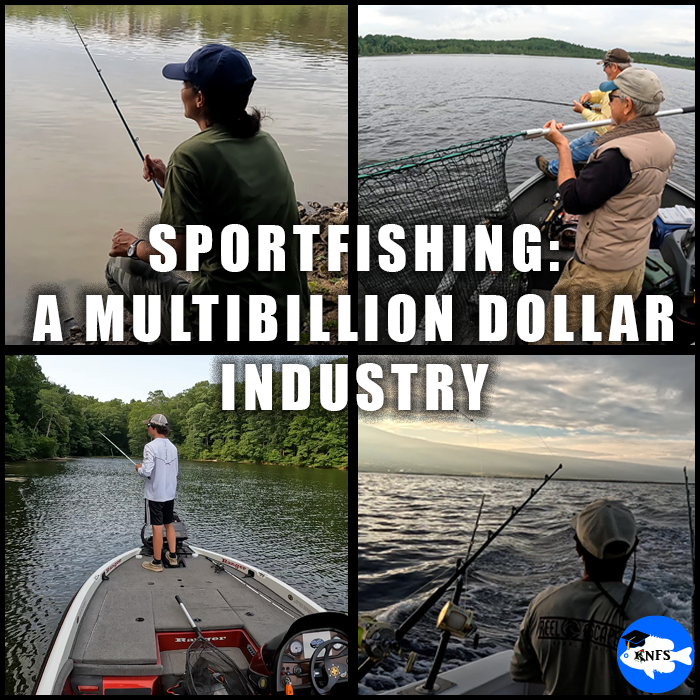
Recreational angling, or sportfishing, is a multibillion-dollar industry that offers a plethora of gear for various species in various seasons in various situations. Don’t let the massive number of products deter you. We’ll keep it simple and still be productive fishers.
This page will focus on rods, reels, and line types, of which, for the purposes of this guide, are considered as gear within the broad category of fishing tackle.
Other essential tackle and baits will be discussed in the next section. Other very useful ‘Extra Gear’ is discussed on another page.
HOW MUCH DOES FISHING COST?
Sportfishing may be enjoyably accomplished within a reasonably tight budget. Many factors will determine how much money an angler could potentially spend on fishing tackle and other related items.
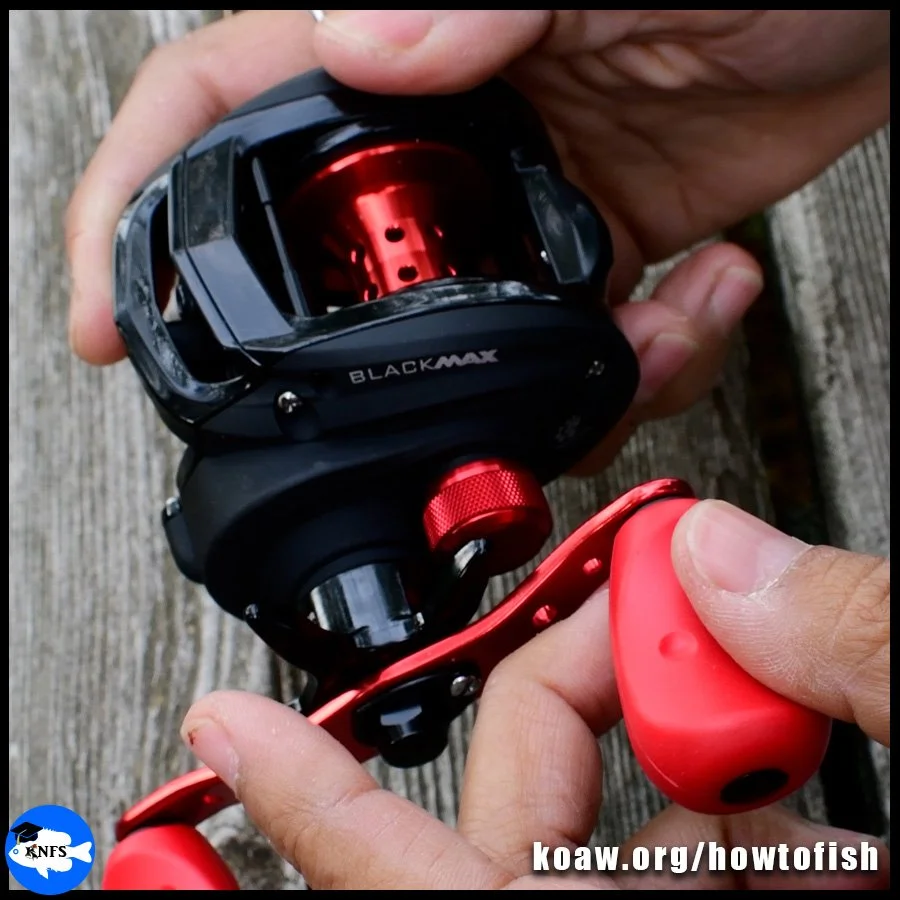
A newly purchased baitcasting reel that is yet to be spooled with fishing line.
GENERAL MINIMUM: If a first-time angler simply wanted to spend the least amount of money to buy all the essential necessary gear new at a store, then it could be approximated that the angler could potentially spend less than $100; (Rod $20 + Reel $30 + Fishing Line $5 + Pliers $6 + Rigging Tackle $20 + Fishing License $15 = $96).
Of course, all of these items would have to be bottom-of-the-line and likely would not perform very well, especially not for a long period of time. (Fishing licenses all vary in prices and duration, as was discussed in the licenses and regulations section.)
PRACTICAL MINIMUM: A total of $182 is a more conservative approximation for how much the essential gear will cost while buying gear that is not bottom-of-the-line but still in the affordable range; (Rod $40 + Reel $60 + Fishing Line $12 + Pliers $15 + Rigging Tackle $40 + Fishing License $15 = $182).
Keep in mind, this approximation doesn’t include other items that most anglers will eventually include in their gear like a tacklebox, filet knife, and landing net. Gas for travel and gear maintenance items should also be in mind. Also, an in-state resident is more likely to buy a fishing license that has a full year of duration before renewing annually.
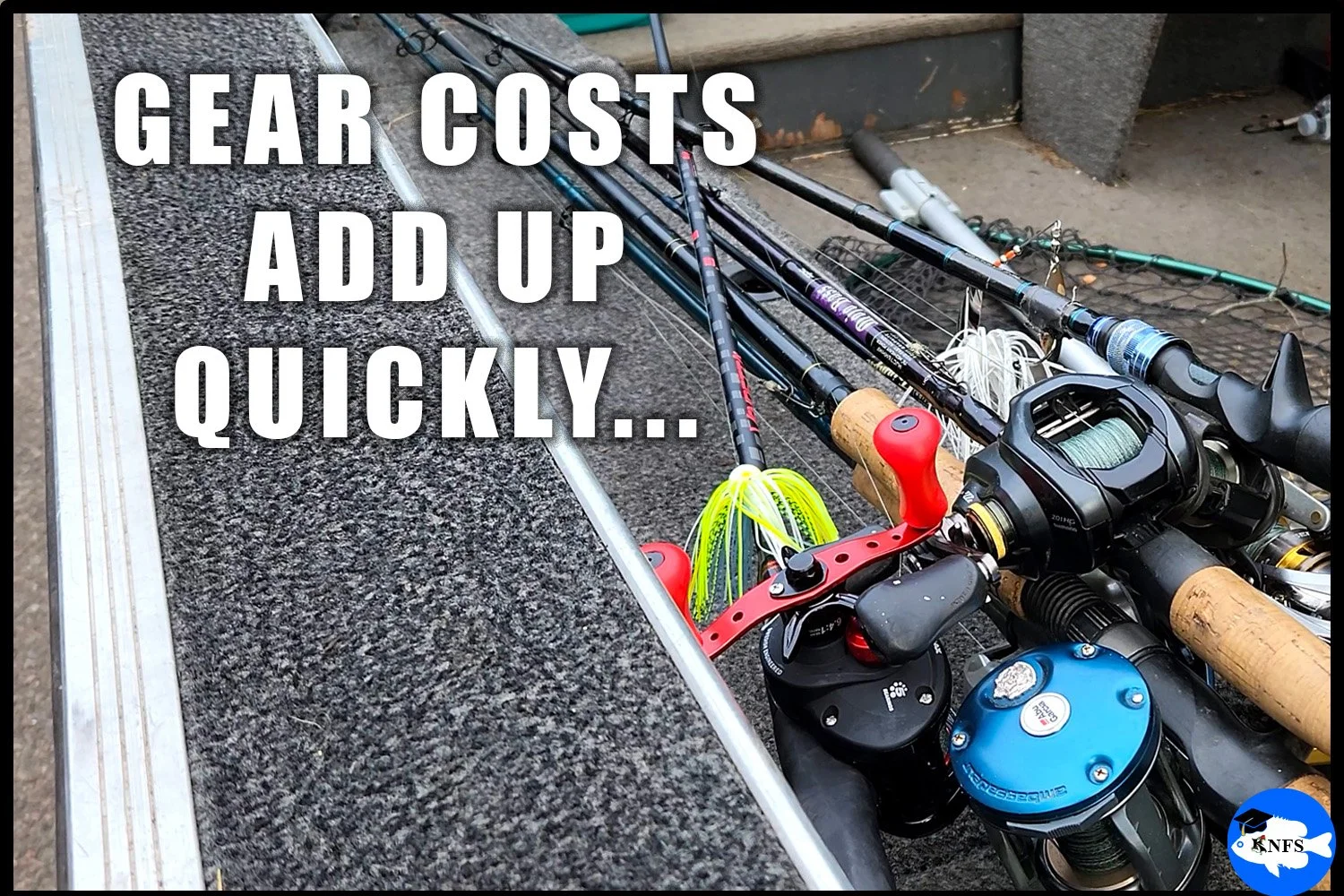
SPORTFISHING CAN BE EXPENSIVE: There is an ongoing discussion in the fishing community on whether or not sportfishing is too expensive. A high-end rod and reel purchase could easily cost more than $1,000. Avid anglers often have at least 3-5 active reels that are respooled with top-notch, more expensive lines, something that should be done yearly at the least. Besides the continual purchases to add lures, baits, and hooks, the other miscellaneous items all add up. And eventually most anglers want a boat of their own that requires a trailer as well as a vehicle capable of towing.
The good news is that fishing does not have to be expensive for the novice angler.
If wanting to become more serious in the sport, that’s when to start making more of the pricier purchases.
YOUR FIRST PIECE OF GEAR
Fishing pliers should be in every fisher’s tacklebox. The Rapala Saltwater Pliers are good for both fresh and saltwater and have cutters.
The first item to purchase is not a rod or reel or fishing line.
Pliers with built-in cutters should be the first item bought for fishing.
Pliers are a safety tool that benefit the fish and the angler. Often a hook is jammed in a fish’s mouth, unable to be removed safely/gently by hand. Pliers will allow for a more efficient method of hook removal. This tool will also aid in rigging, like cutting line and squeezing sinkers.
Fishing pliers, somewhat similar to pliers found in a garage, come in various types and sizes, some with bonus features for certain rigging methods. I usually have 2 or 3 different types of fishing pliers with me at all times because I’m often targeting different sizes of fishes. I need small, thin needle-nosed pliers for small species and large, stronger pliers for the bigger species. I also want some pliers to help with squeeze sinkers and add/remove split rings.
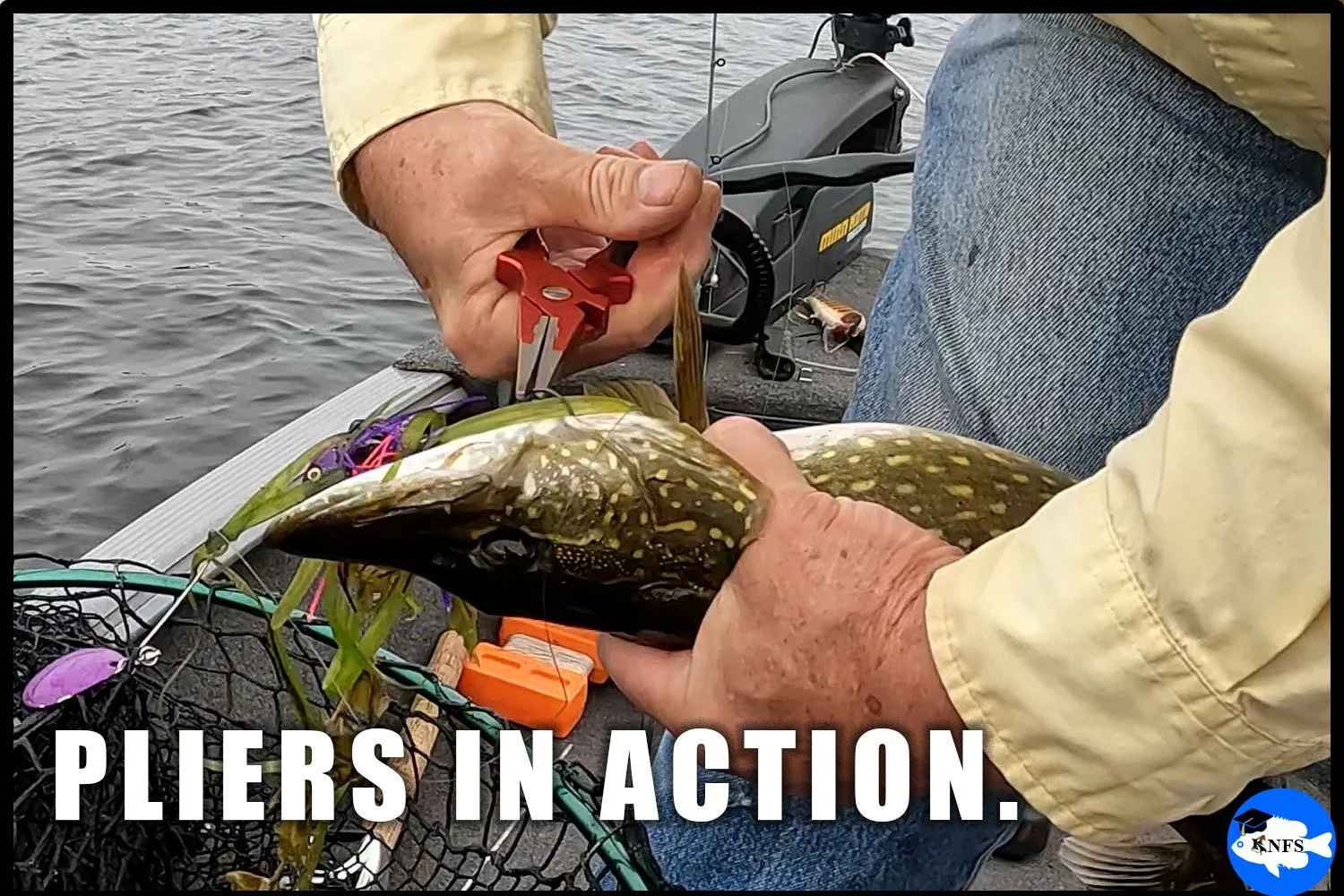
An angler uses pliers to extract a hook from a Northern Pike, a species with very sharp teeth.
Ideal fishing pliers are stainless steel, strong, and have built in line-cutters.
If your pliers do not have line cutters, then buy a small pair of scissors or nail clippers because a device to cut line is also necessary.
For the convenience of new anglers wanting to be directed to the exact type of recommended gear on this page, certain links on this page will direct you to Amazon where, at no additional cost to you, a purchase of an item within that link may or may not give Koaw Nature/KNFS a small finder’s fee. I appreciate your support of KNFS!
I also recommend having bolt cutters for anglers going after larger fishes; thicker hooks may need to be cut to safely remove a fish from netting.
ROD AND REEL COMBO - FAST & EASY
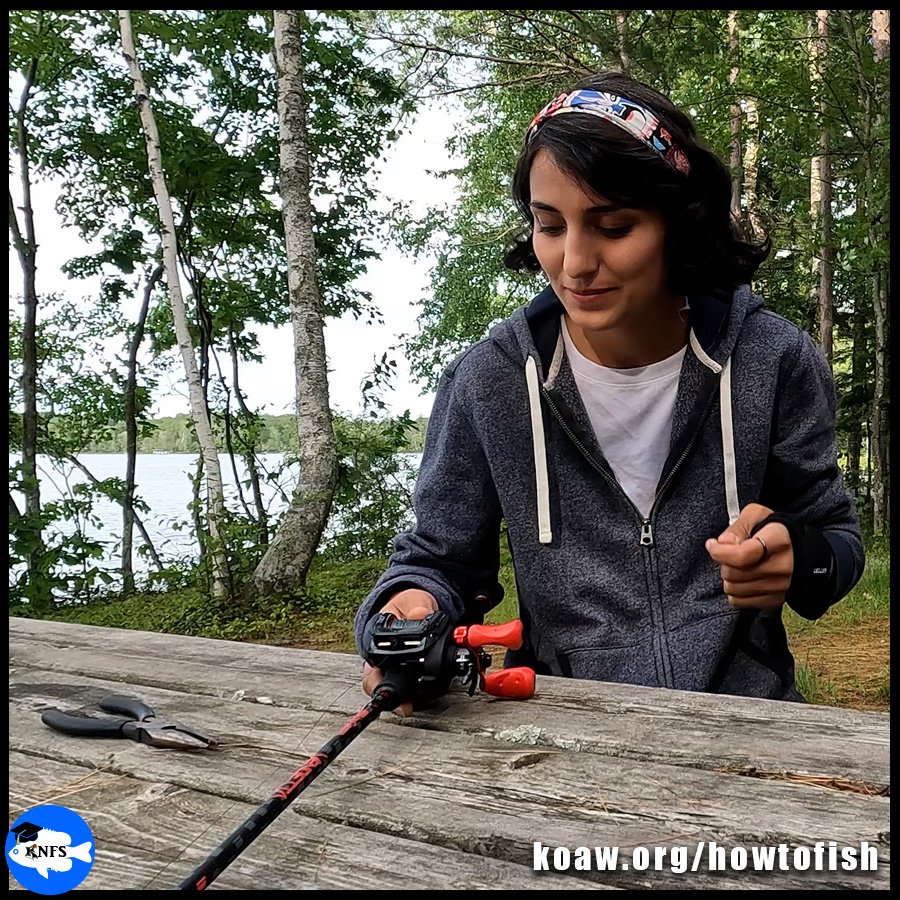
An angler getting ready to spool her very first rod and reel combo.
A new angler that’s first wanting to ‘test the waters’ of sportfishing and not commit to spending a lot of money should buy a moderately cheap $50-$80 rod-and-reel combo.
A rod and reel combo describes when both the rod and the reel are sold together as a matching pair.
Reels and rods are often sold separately but are also sold in combination. These combos are sometimes already spooled with fishing line (albeit often poor line) and are essentially ready-to-use after purchase. This affordable combo will be good at targeting the small-to-medium species of fishes that we’ll discuss how to catch later in this guide. A rod-and-reel combo purchase is simple and doesn’t complicate things.
Buying a rod-and-reel combo means a new angler won’t accidently buy a rod and a reel that are incompatible with each other.
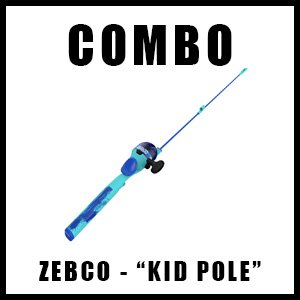
FOR YOUNG KIDS - Push-Button (Spincast) with a ‘Kiddie Pole’ - 2.5 - 4 ft length. These are usually sold with designs of various Disney and other animated characters. This combo costs usually between $10-$20. The quality and longevity of these cheap combos is poor yet, the setup will still serve the purpose of teaching kids basic casting mechanics.
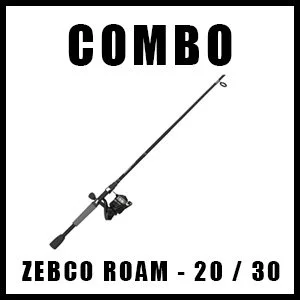
FOR TEENS/ADULTS - Spinning Reel/Spinning Rod Combo: A small to medium spinning reel. A rod of 6 - 7 ft length, medium-light power, with fast to moderate-fast action; (one marketed as “multispecies”.) An affordable combo usually is around $50-$80. At this price, it won’t be topnotch gear, but it’ll suffice as good introductory gear for a new angler. If money isn’t an issue, buying better gear is encouraged if the angler knows what type of rod and reel are desired.
Below are some pre-spooled (with fishing line) options that are affordable on Amazon.
SALTWATER VS. FRESHWATER: These days, most rods and reels can be used interchangeably between fresh and saltwater systems. Though, some tackle will not be good for use in saltwater; this compatibility should be listed on the product’s packaging.
Spincast reels, with a closed cover, are harder to maintain after saltwater expeditions as there is more opportunity for salt to be stuck inside the reel.
The eyes of certain rods, if not coated in a protective material, may corrode even after one saltwater fishing expedition.
Tackle labeled for saltwater use is not immune to the corrosive effects of salty waters. After saltwater fishing, always wash the tackle in freshwater to remove the buildup of salts. Properly cleaning and lubricating metal parts on any equipment used in saltwater must be done with regular frequency. Meanwhile, items used in freshwater systems can endure with less maintenance.
THE REEL
There are 6 main general types of reels for rod-and-reel fishing here in the United States where we will discuss 3 of them in more detail: The spincasting (‘button-push’) reel, the spinning reel, and the baitcasting reel. Conventional reels, flycasting reels, and lever drag (big-game) reels aren’t discussed here. We’ll discuss how to operate each of the first three reel types as well in a casting section.
Reels are sold highlighting a number of features including but not limited to:
If the reel does not come with a manual, then seek out a copy online.
LINE CAPACITY: This describes how much line the reel is capable of holding. Manufacturers often list the line capacity for both braided line and monofilament line at specific line strengths.
Ex: On the reel’s information packet, this information may be shown: Monofilament Line Capacity (pound - yard) - 12-230; 14-180, 17-150, Braided Line Capacity (pound - yard) - 40-195, 50-190, 65-125.
Where this reel can hold approximately 180 yards of 14-pound monofilament line and 190 yards of 50-pound braided line.Keep in mind that different brands of fishing line will have different line diameters even if the strength is the same, ergo, these line capacities for reels can be thought of as general approximations. These listed capacities are also subtle suggestions for the range of line weights/tests that should be paired with the reel.
LINE RETRIEVE PER CRANK: This term describes how much line will respool per one crank, usually described in inches here in the United States. Again, line retrieval per crank will be dependent on other factors, such as how much line is already on the spool, so this is more of an approximating feature.
MAX DRAG: Describes the amount of force needed to pull line from the spool when set at a max setting. A max drag listed on a reel of 10 lb. will approximately need about 10 lb. of force to pull out line when set at the max setting. The reel will likely have an adjustable drag (a physical mechanism) that allows for more or less friction to be exerted therefore acting to increase or decrease the drag force. A correctly set drag is important to properly fight a fish.
WEIGHT: Describes how much the reel weighs. Some anglers who cast a lot do not want to hold a heavier reel for a long time.
GEAR RATIO: Describes how many times the spool or rotor turn after one crank of the handle. Typically, a low gear ratio is around 3.5:1 and a high gear ratio is around 6:1 - 6.5:1. High gear ratio reels are sometimes referred to as “high speed reels”, however, there are a number of factors that go into the speed of a reel, or how fast it can move a lure through the water, such as spool size. If there are two reels with the same gear ratio, the reel with the larger spool size will have a greater speed of line retrieval. Low gear ratio reels are more often built for power and high gear ratio reels for speed.
Often, when buying a rod and reel combo, there won’t be a box and/or manual available with the reel. The manufacturer will most likely have the reel manual and specifications freely available online.
SPINCAST / BUTTON-PUSH REEL
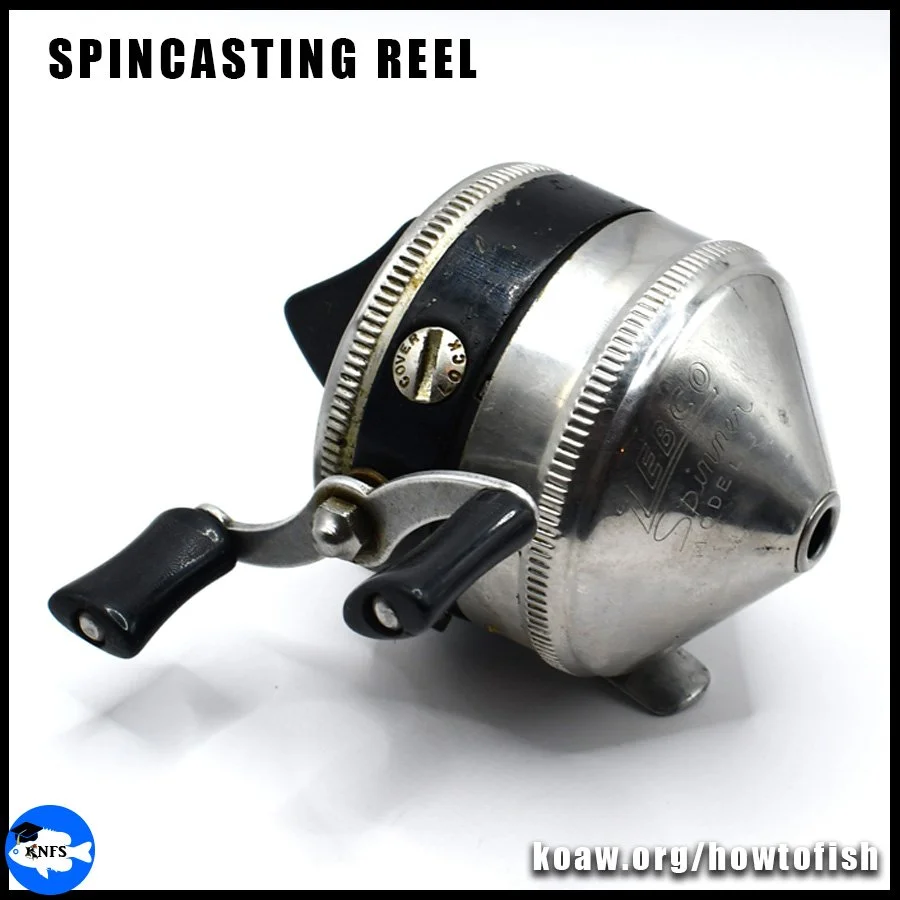
The spincasting, or button-push reel, is the easiest to learn on. For young kids, this is the reel type that I will start them off with. For new anglers in their teens and older, I will start them out on the spinning reel.
The main advantage of the spincast reel is the simplicity of use. An angler just needs to press and hold a button, begin the cast, and let go of the button at the end of the cast. Some disadvantages of spincast reels are that they are trickier to respool and generally cannot cast as far as spinning reels. Also, because of the closed cover, errors with the line (tangles) are harder to detect.
Getting a cheap, pre-spooled spincast reel still remains the best way to teach kids the basic mechanics of fishing.
Learn to cast with this reel here!
SPINNING REEL
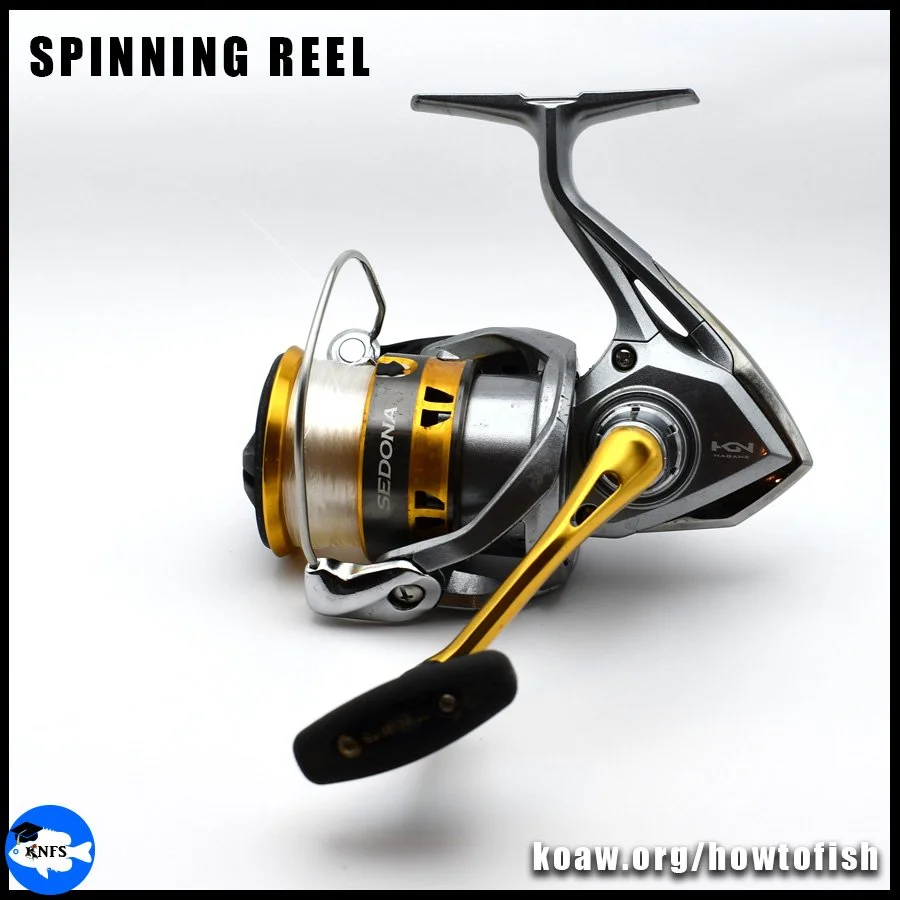
The spinning reel is a great reel to learn on. This reel type is commonly used by novice and experienced anglers. The spinning reel is very simple to use and hardly ever causes line tangles.
Spinning reels come in various sizes with various features. Spinning reels are used for inland fishing for small-to-medium species, however, spinning reels are not excluded from saltwater use for many species of various sizes, including large species, like billfishes. Compared to spincasting reels and baitcasting reels, spinning reels generally have greater casting distance and hardly ever backlash, or cause line tangles. The handles are often interchangeable to accommodate anglers preferring a left or right-seated handle.
Learn to cast with this reel here!
BAITCASTER
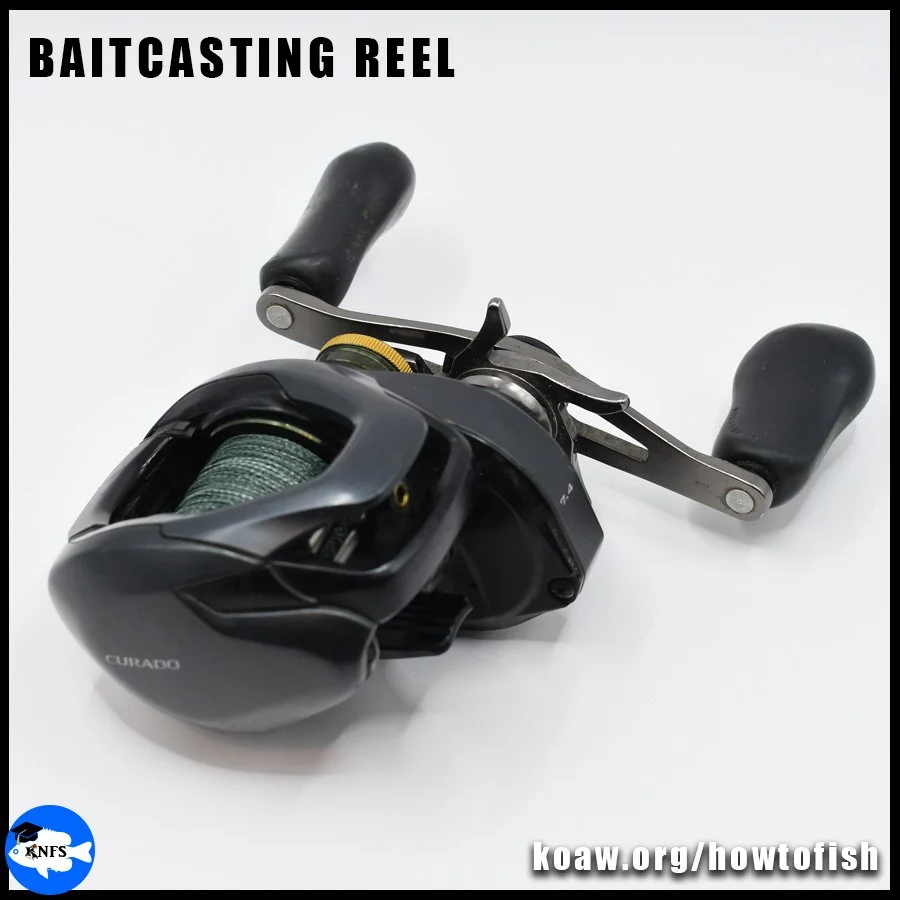
The baitcaster, or baitcasting reel, is a reel type that requires more awareness when fishing, especially if casting. The primary advantages of a baitcaster comes with cast accuracy, increased cranking power, and better control during fights with strong fish.
Baitcasters are not limited to live-bait, in fact, these reels are often casting artificial lures, sometimes used for trolling. Baitcasters are typically used for targeting medium to medium-large species of fishes.
The baitcaster is more prone to ‘bird’s nest’, or backlash with line tangle, compared to a spinning reel because the baitcaster has a free-spinning spool. This spool requires the angler’s control via a thumb manually braking. However, these days, especially on higher-end models, the technology and braking systems (some of them electronic), do better to minimize these line tangles that emerge from the free-spinning spool.
Conventional reels are very similar to baitcaster reels, and in basic principles, operate with the same casting mechanics.
Learn to cast with this reel here!
BUYING A REEL
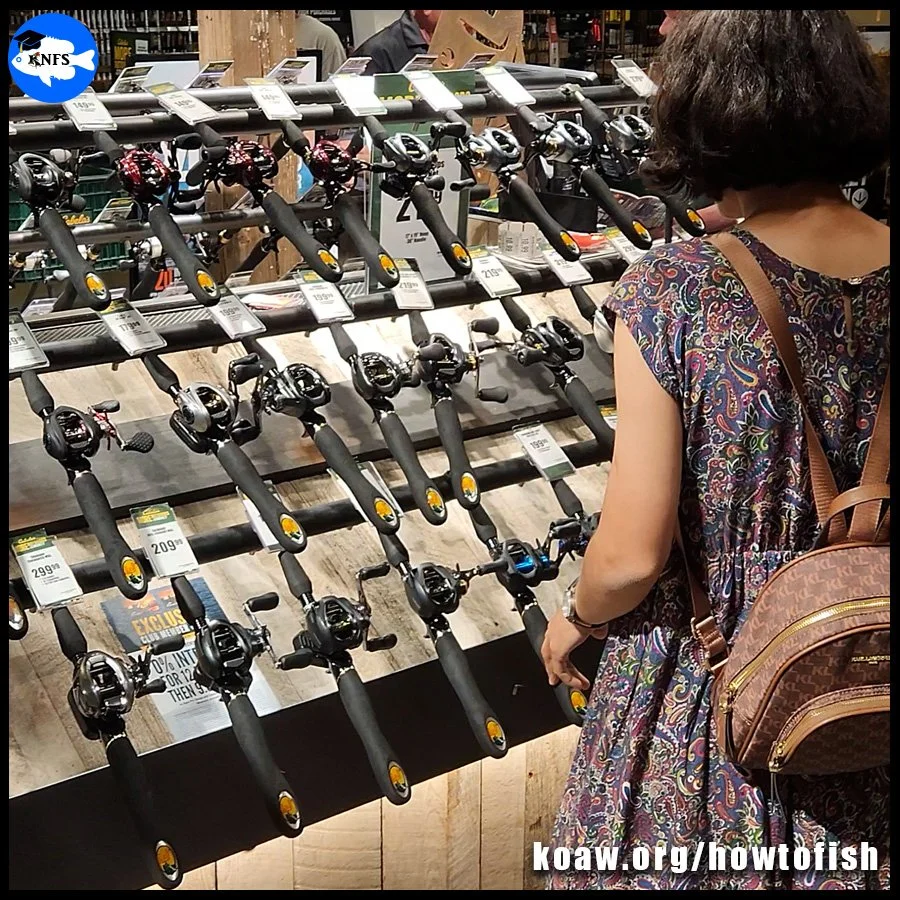
Buying a reel is an exciting endeavor; it can also be intimidating. As has been mentioned before, there are 6 general reel types that dominate the market made by many companies all offering many models with many features. Some reels are specialized for certain types of fishing while most reels are multipurpose for multispecies.
The reel is the ultimate workhorse (besides the angler) behind the fishing expedition. As anglers, we want a reel that is willing to work as hard as we do while having a healthy lifespan.
There really are two options for the new angler wanting to buy a new reel:
OPTION 1: Get a cheap reel and see if that type (spinning, baitcaster, etc.) is comfortable. However, that cheap reel may not perform at a high level or even last through an initial fishing season.
OPTION 2: Get a quality reel that will likely perform very well over a long period of time. In this case, a lot of money is devoted to a certain reel with certain specifications—hopefully the angler is happy to have this reel for many years.
Basically, either go cheap first and see what features are liked/disliked so the next purchase is of a quality reel where the wanted features are known or, go expensive and have a nice reel that will likely last a lifetime if properly maintained. Ideally, if a new angler is able to borrow or try another angler’s gear first, that is best.
Reels require maintenance to function correctly. Consult the owner’s manual to understand what needs to be done to a reel to keep performance high.
The two affordable options below to Amazon I have not tried but seem appropriate for a new angler seeking a cheap reel. The other two options, the Shimano Sedona FI and the Shimano Curado K, are two quality-made models that I own and use frequently. (I still use an older version of the Shimano Curado, a reel I’ve used for 25+ years! The Curado K is just a newer version with material and design upgrades.)
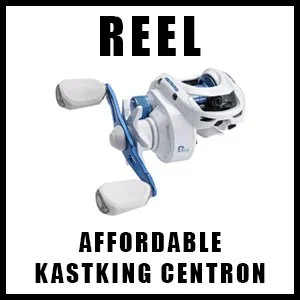
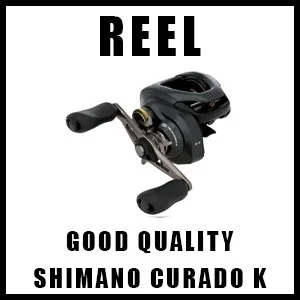
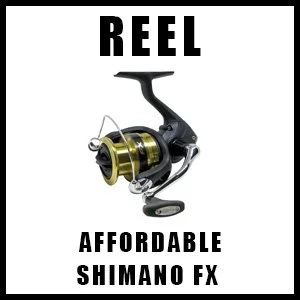
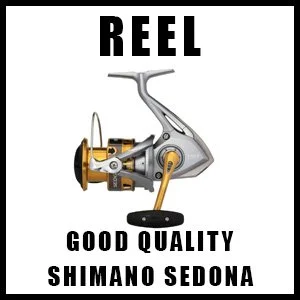
If buying a baitcaster, make sure the handle is seated on the side that you prefer, either left or right. (The vast majority of anglers fish with the handle on the right for baitcasters.) Spinning reels usually have easily interchangeable handles that an angler can switch between left and right.
RODS
The rod is the lengthy extension that holds the reel and will guide the line. A rod is composed of a reel seat, a shaft (blank), and handle. The guides, or eyelets, are the roundly extensions on the blank the guide the line. Rods may be made of various materials and come in numerous types and styles, generally made to pair with a certain type of reel. Rods are often described as spinning rods (paired with spinning reels), baitcasting/casting rods (paired with baitcasting reels), spincast rods, surf rods, and so forth.
Rod features have no industry standard, therefore, one company’s description of a “medium fast rod” may be different from another’s. When buying a rod there are a handful of features that will be most evident on the labeling:
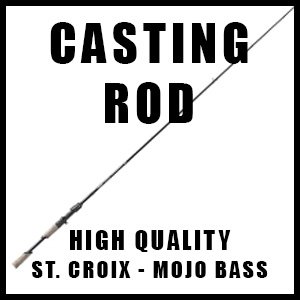
Above are the printed-on features of the St. Croix Mojo Bass rod.
LENGTH: Rod length most greatly affects casting distance. Ice fishing rods are often very short (only a few feet or less) as there’s not much casting. Bass rods are often around 7’ in length as these anglers are often casting lures to a distance. A longer rod has a faster tip velocity than a shorter rod, generally meaning the casts will go farther on the longer rod.
POWER: The power of a rod refers to the amount of energy needed to flex a rod; the more strength needed to bend the rod then the higher power that rod has. Power of a rod is determined by the materials and build of a rod. Often rod power is described by terms like light, medium-light, medium, and heavy.
Ergo, if an angler is targeting big, heavy fish then that angler will likely want to use a heavy rod.
ACTION: The action of a rod is describing where the rod flexes, either near the tip (for fast rods) or more near the base (for slow rods.) Fast action rods allow the angler to better feel the vibrations of a lure and the fight of a fish compared to slow action rods. Both power and action, determined by the rod’s build and materials, lead to certain efficiencies with certain methods of fishing. Often rod action is described by terms like slow, moderate, moderate-fast, fast, and extra fast.
LINE & LURE WEIGHT: Each rod will likely have written on the base of the blank a suggested range of lure and line weights.
For example, a light 6’ spinning rod will likely suggest lures in a weight range of 1/8 to 1/2 oz. with a line weight of 4-10 lb. for greatest efficiency. Attempting to cast a larger lure, something around 1 oz., will likely cause this rod to flex too much, reducing the rod’s efficiency, leading to greater angler fatigue and possibly rod failure.
BUYING A ROD
Buying a new rod doesn’t have to be too intimidating, Just pay mind to the two most important aspects of purchasing a new rod:
MATCH THE REEL TYPE: Ensure that the reel and the rod type match. Most all rods will clearly label what they are.
A spinning rod pairs with a spinning reel.
A baitcaster rod (often called a casting rod) pairs with a baitcasting reel.
A spincast rod pairs with a spincasting reel.
Note that a baitcaster rod and spincast reel will work with each other, as well as a baitcaster reel and spincast rod. In essence, anything labeled as a “casting rod” is really usable for both baitcaster and spincast reels.
In most all cases, rods can take both a right-handed reel and a left-handed reel. As in, you could swap out a right-handed reel from a rod and put a left-handed reel onto that same rod without losing any functionalities.
MATCH THE REEL CAPACITIES: If you bought a fairly small spinning reel, such as a Shimano Sedona 1000, then this reel is meant to target mostly small species. Pairing this reel with a 7’7” heavy, slow action rod would be unorthodox in most situations as this rod is meant for big lures, thicker line, and more powerful fishes. A better match for this small reel would be a 6’ or 6’6” light to medium-light rod with fast to medium-fast action.
If a new angler wants to start out Musky fishing, going after one of North America’s largest inland fishes, then that 7’7” heavy, slow action rod would be good for heavy lures. Musky fishing with somewhat less heavy lures would be better achieved with a medium-heavy rod with faster action. The small Sedona 1000 reel, however, would be a poor choice to pair with a heavy rod for targeting a species that large; much more cranking power and drag capacity would be needed on the reel.
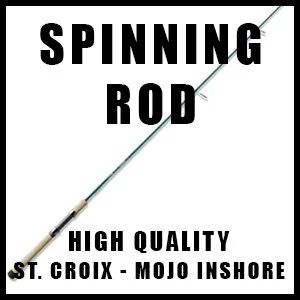
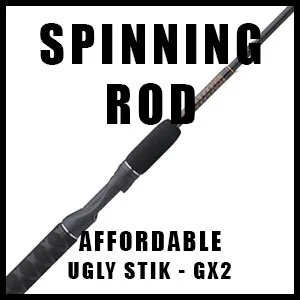
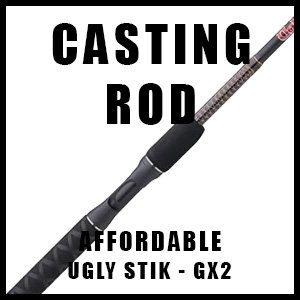
Below are a few rod suggestions of mine that you could pick up on Amazon; I personally use St. Croix rods (almost exclusively now)—but Ugly Stik rods are well-known for being reliable.
ONE PIECE OR TWO PIECES?
Rods may be sold as a single piece or in multiple pieces that you can quickly combine. Personally, I will not buy a rod that is not a single piece. However, multiple piece rods can be advantageous for anyone needing to compact the rod during travel. Really, I wouldn’t advise anyone to buy anything other than a one piece rod unless travel space is an issue.
For a new angler targeting small-to-medium species (like Largemouth Bass):
I suggest getting a rod that is 6’ 6” to 7’ length, medium-light to medium in power, and moderate to moderate-fast in action. These middle-ground options offer a bit of flexibility for targeting various species of different sizes. Pairing a rod with these capacities with any 2000-3000 series (small-to-medium sized) spinning reel is a good option.
LINE TYPES
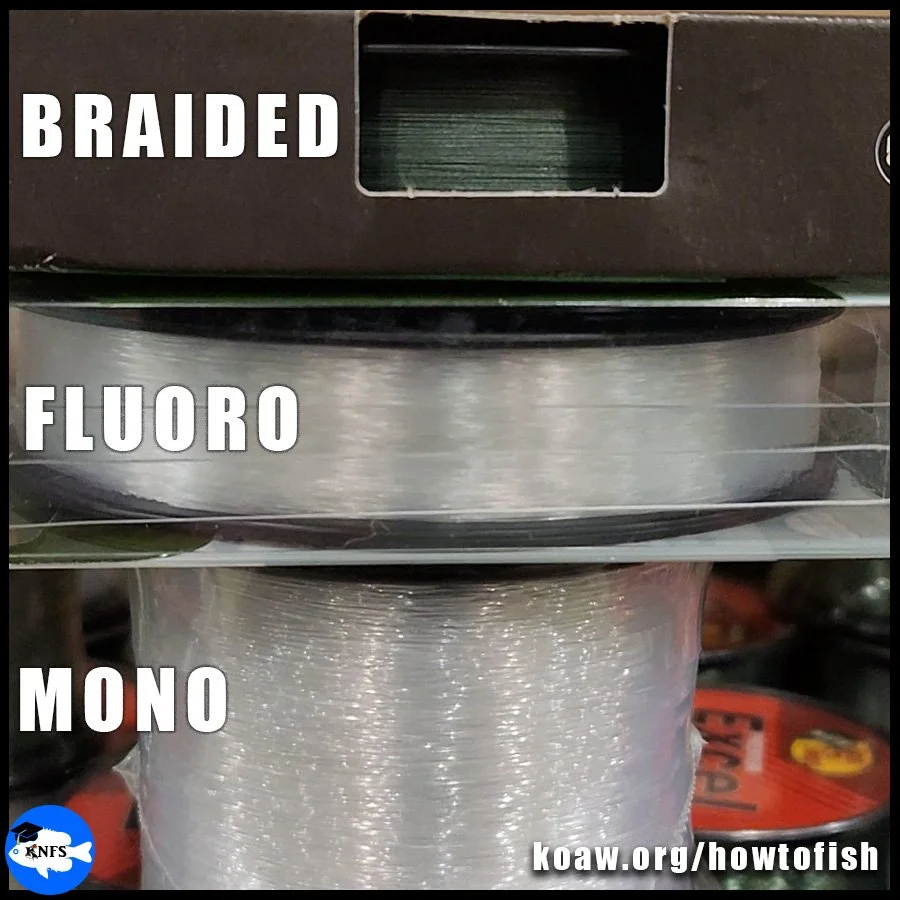
The three main types of line that often pair with the reels we’ve discussed are monofilament, fluorocarbon, and braided. Each type comes in various strengths, colors/visibilities, and diameters. Each company uses different materials and techniques to manipulate the performance of their final product.
LINE TEST STRENGTH (WEIGHT): Line is typically categorized by test strength (sometimes called weight), or how much force the line can endure without breaking. Test strength is a rather ambiguous term because it doesn’t refer to the strength of the line when wet, where wet line often has a lower breaking strength. Also, test strength often just imprecisely estimates the breaking strength of the line. The breaking strength of most lines is actually above the listed test strength meaning anglers are often fishing with much stronger line than they think.
LINE CLASS: Line class is similar to test strength but is a line characteristic more relevant to anglers seeking fishing records and/or in a tournament requiring a certain class of line. Class line should break below or sometimes at the strength listing of that line (if manufactured properly.) Typically, strict tournaments and record keeping organizations (like the IGFA) will test an angler’s line to make sure that the fish was caught with an appropriate line class; if the line is tested and breaks after applying more force than the rated strength, then that angler’s catch will be disqualified.
Use an ARBOR KNOT to attach line to a reel (video demonstration here.)
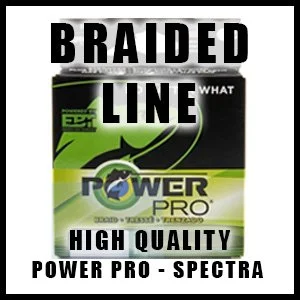
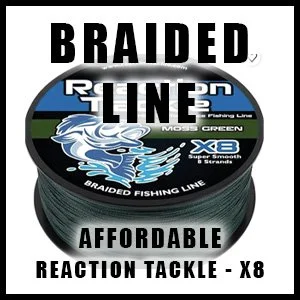
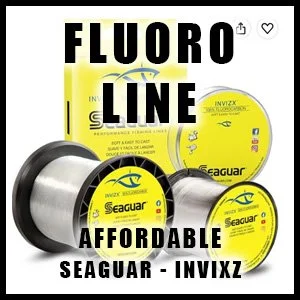
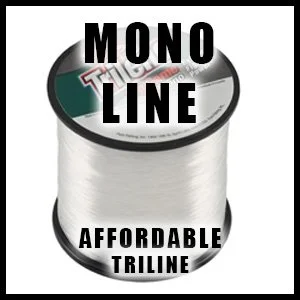
Click to enlarge. Three types of fishing line all rated at 6 lb-test strength: braided, mono, and fluoro (from left to right, respectively.) The blue circles indicate where on the packing the line type is described.
MONOFILAMENT LINE - This line type is typically made from nylon, nylon alloys, and similar polymers. Often just called “mono line”, this line type is of a single, mostly clear strand, unless tinted another color. This is the cheapest line to buy. Monofilament line has the highest amount of stretch, sometimes up to 30%. The more stretch, the less likely an angler is able to set a hook properly and control the fight from a fish.
FLUOROCARBON LINE - Also called “fluoro line” for short, this line type is made of a monofilament nylon alloy. Fluorocarbon line is denser than the basic monofilament line therefore is stronger at the same line diameter. This density has the line more prone to sinking. Also, fluoro line does not absorb water, while mono line absorbs water, meaning the breaking strength of fluoro remains mostly the same in and out of water while the breaking strength of mono line decreases when wet. Furthermore, fluoro line has a lower refractive index than mono, meaning its visibility underwater is lessened. Fluorocarbon line has less stretch than basic monofilament line but more stretch than braided.
BRAIDED LINE - Braided line consists of multiple wrapped strands of microfilaments, consisting of various materials such as polyethylene and aramid fibers. Compared to the monofilament lines, braided line offers very strong line at thinner diameters with more line sensitivity. There is very little stretch with braided line, meaning an angler must be very aware of the force they are exerting on a hookset; pulling too hard with too tight of a drag setting will cause the line to break or just completely pull the hook through the fish’s mouth. Braided line typically is less abrasion resistant than the monofilament lines. Braided line typically floats.
There are fused lines, which are somewhat similar to braided line, where the same materials used for braided are fused together, offering a less-expensive option compared to traditional braided line.
BUYING FISHING LINE
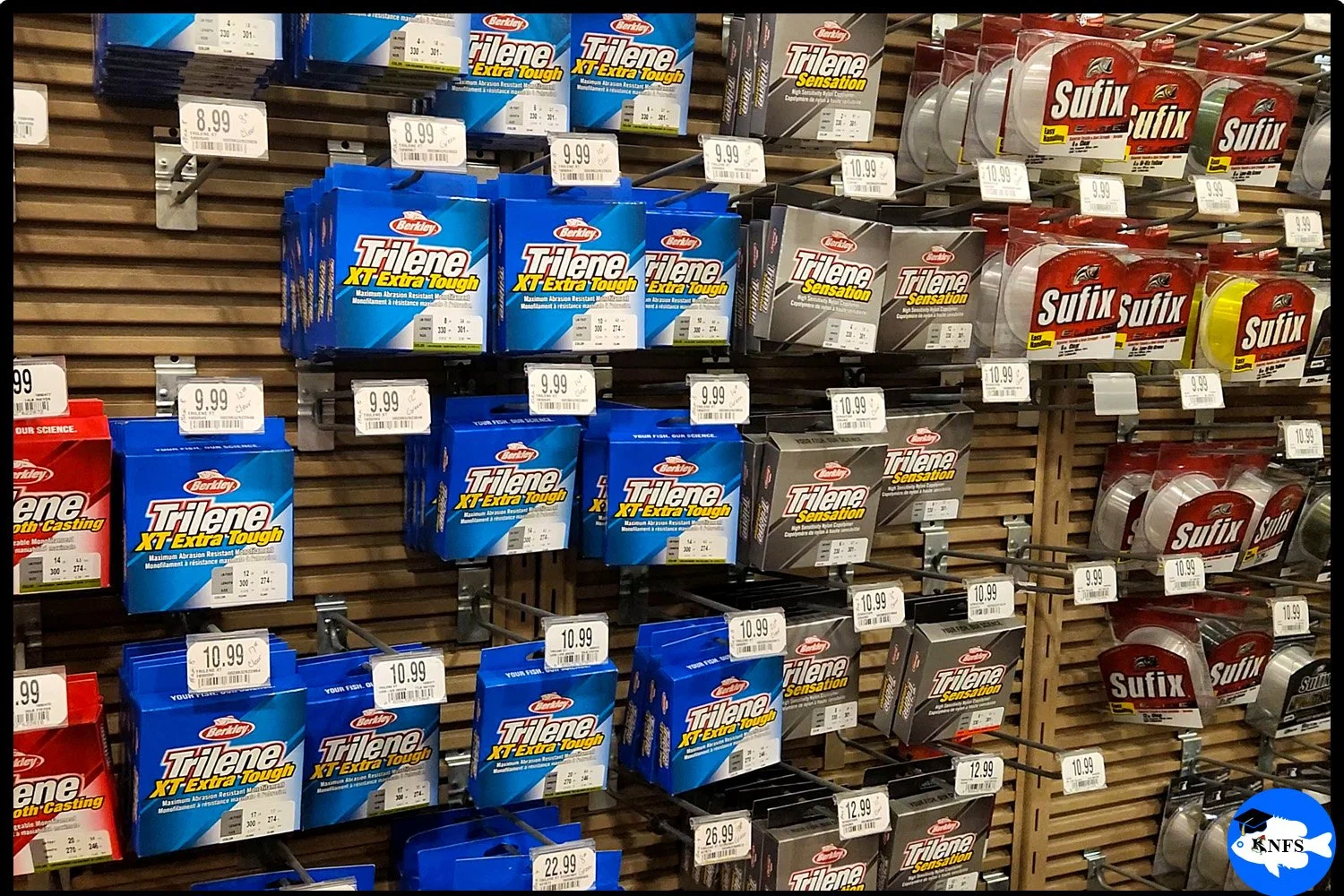
Fishing line in a store.
Fishing line should be purchased to match the gear it will be paired with and the fishing methods to be implemented. If we think back on the features of the rods, each rod should list a suggested line test strength. A rod suggesting a line test (weight) of 4-10 lb. should pair with line that is within that range, or just slightly out of that range. Also, if we think back on what we discussed about the line capacity of a reel, these line weight suggestions will inform a good approximation of what line types will pair well with the reel.
You can spool any of the reel types we’ve discussed (baitcaster, spinning, and spincast) with any of the line types we’ve discussed (mono, fluoro, and braided.)
Sometimes anglers will spool a reel with braided line and use a heavier fluoro or basic monofilament line as a leader, or an extension at the end of the line, because the monofilament line will have high abrasive resistance.
Monofilament is the cheapest to buy. For new anglers, this may be a good purchase simply because novices are more likely to lose a lot of line via snags and reel tangles; (we’ve all seen bobbers and fishing line hanging from trees along lakes and rivers.) New anglers are more likely to lose line. Buying a 300-500 yard spool of monofilament line will cost less than $10 for most brands. Personally, I rarely ever use monofilament line; I find both the high elasticity (stretch) and plasticity (memory) of this line type to be unpleasant to work with.
If money is not a worry, fluorocarbon line is more often a better choice than basic monofilament line. Fluorocarbon is also great for new anglers because it offers stretch, but not too much stretch, meaning an angler will have more forgiveness compared to using braided line during a fight should the drag not be set correctly.
However, fluorocarbon still has a certain amount of plasticity (memory) that may require detangling, especially on a spinning reel. Also, spooling a baitcaster with fluorocarbon is not advised for a novice angler—the backlashes, or ‘bird’s nests’, created with fluorocarbon are much harder to detangle compared to braided line because fluoro more easily tightens on itself while braided line has more slip. Often, a fluorocarbon tangle on a baitcaster requires cutting the line and, depending on how much line is lost, may require completely respooling that reel.
Braided line is a great choice for baitcasters. Anglers using spinning reels are more likely to spool their spinning reel with fluoro and mono rather than with braided line. Again, braided line offers greater strength at a smaller line diameter than the monofilament lines. The combination of great sensitivity, or an ability for the angler to detect the movements of a fish, and the lack of line stretch offers superb control of a fight with a fish.
NEXT: BASIC TACKLE