A Smallmouth Bass (Micropterus dolomieu) being held by the lower jaw as well as being supported under the belly to prevent damage to the vertebrae.
There are over 37,000 living species of fishes in the world (as of 2026) with a vast spectrum of physical features.
In the contiguous United States, there are ~3,000 species of fishes. Most of these species are not encountered by sportfishing anglers.
Even still, the popular fishes sought by recreational anglers have differing features that will require specific handling methods.
Eventually you will learn the most commonly encountered fishes in your area and gain a familiarity with them.
Safely handling one type of fish may require a very different method from another type of fish.
HOW TO HOLD SPECIFIC TYPES OF FISHES:
Great news! More pages to this section will be added as time goes on.
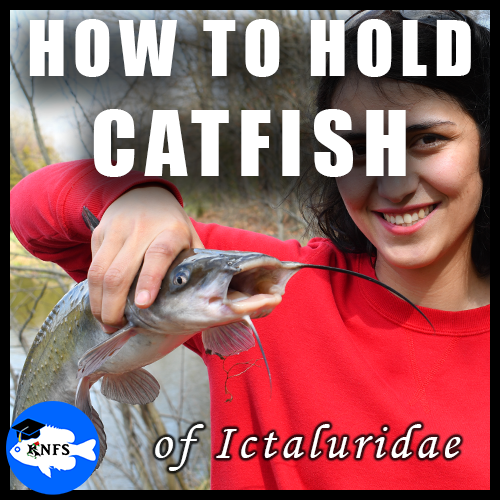
Disclaimer: Hold and process fish at your own risk. There is always potential risk of incurring harm to your body when fishing and handling fish, even if all precautions are followed.
ANGLER SAFETY
If unaware of what species a fish is then approach that fish with every caution as some fishes have:
SHARP SPINES: Many fishes have very sharp spines in different fins. All the centrarchids (Largemouth Bass, Bluegill, etc.) have sharp spines in some of their fins. Certain spines on some species even have toxins that can be injected as a venom, such as in certain catfishes and scorpionfishes. Certain rays may have sharp, sometimes venomous, boney blades capable of severely damaging, or even killing, a human.
SHARP TEETH: Sharp teeth are commonly encountered in gamefishes. Walleye, Northern Pike, Muskellunge, and all gars are commonly encountered freshwater fishes that an angler would not want to ‘lip’, or hold barehanded by the mouth, because of the numerous sharp teeth. Lingcods, most sharks, and barracudas are examples of saltwater fishes that have large, sharp teeth. Meanwhile, the commonly sought-after Largemouth Bass has teeth more like sandpaper and is often lipped by anglers without damaging (too much) the angler’s fingers. Any cut sustained by an angler in water is likely to be flooded with a bunch of bacteria whether that bacteria was in the fish’s mouth or just in the water; if having been cut by the teeth of a fish, this allows bacteria to further penetrate an angler’s skin.
SHARP SCALES: The scales on some fishes may be sharp and rough, easily capable of cutting a hand if handled improperly. Species like Longnose Gar and Walleye both have scales that are not so pleasant to rub the wrong way barehand; same goes for sharks.
ELECTRICITY: There are a number of fishes capable of producing an electric discharge that sometimes can be quite dangerous. Fortunately, inland anglers in the United States are unlikely to encounter these dangerous species simply because they are not found in this part of the world. In saltwater, there are some electric rays, like the Pacific Electric Ray, capable of producing a nasty shock.
SPORADIC MOVEMENTS: A fish out-of-water is typically not a happy fish. It’s important to firmly hold a fish to prevent it from throwing a hook into an angler, or just physically whacking an angler. A large fish flailing about is capable of producing a lot of force.
FISH SAFETY
Angler safety and fish safety are both important to consider when holding a fish. Even if we plan on harvesting, or eating a fish, there is no need to improperly handle the fish to cause more discomfort to the fish than need be. Many anglers will practice catch-and-release fishing, ergo it’s essential that a fish is returned to the water in good condition. Here are some things to consider about the fish’s health:
MUCUS MEMBRANE: Many species have a slimy, mucus membrane on the dermal layer (outside of their body.)
The mucus membrane is hard to see with the naked eye.
This membrane serves many valuable functions to a fish such as disease protection, osmoregulation functions, and locomotory efficiencies. When handling a fish, try to have wet hands/gloves to reduce the amount of mucus removed from the fish’s body.
At the very least, when grabbing a fish, attempt to avoid rubbing motions that would remove a good portion of the mucus membrane.
DEHOOK GENTLY: Dehooking a fish should be done with pliers if unable to easily remove a hook by hand. Whacking a hook out of a fish’s mouth is not advisable as there is chance to hit the fish’s head causing further damage.
Make sure that the fish is secure with a firm hold to prevent the fish from thrashing around.
A trophy-sized Longnose Gar is tough to hold—they want to thrash about and have sharp scales, teeth, and spines. Shows roughly the max bend of the spine that shouldn’t damage the fish for a short duration outside of water.
MIND THE SPINE: The spine here is referring to the vertebral nerves that, in most fishes, are protected by bone. We want to make sure we are not bending this spine so that it breaks. This is especially important with larger fishes and cartilaginous fishes (sharks, skates, and rays). Use holds that evenly support the weight of the entire fish when moving/holding a fish.
Usually, a hold under the belly and at the head will ensure the spine will not bend to a degree that will cause damage to the fish.
Any fish bigger than the one in the adjacent photo would likely require two people to help hold the fish to better support the weight.
This is a homemade cradle net made by Koaw that is great for measuring large fish while they are in the water. Jimbo is measuring his 40+ inch Muskie with the help of Nick.
WATER: Most fishes live their entire lives in water. Removing a fish from water immediately causes stress hormone release and chemical imbalance. Fish also struggle to breathe outside of water; most gamefishes will not die if held outside of water for a minute or so, some are much hardier while other species cannot tolerate even a minute outside of water.
If able, attempt to keep the fish in the water while dehooking, when finding the camera for the photos, and as much as possible.
Otherwise, be very quick about dehooking the fish, getting your photo, and getting the fish back into the water.
I would encourage all microfishing anglers to bring small tanks with them. Not only are the photos much better, but smaller specimens are often much more susceptible to being removed from water.
Muskellunge (Esox masquinongy) getting ready to be measured as part of a survey.
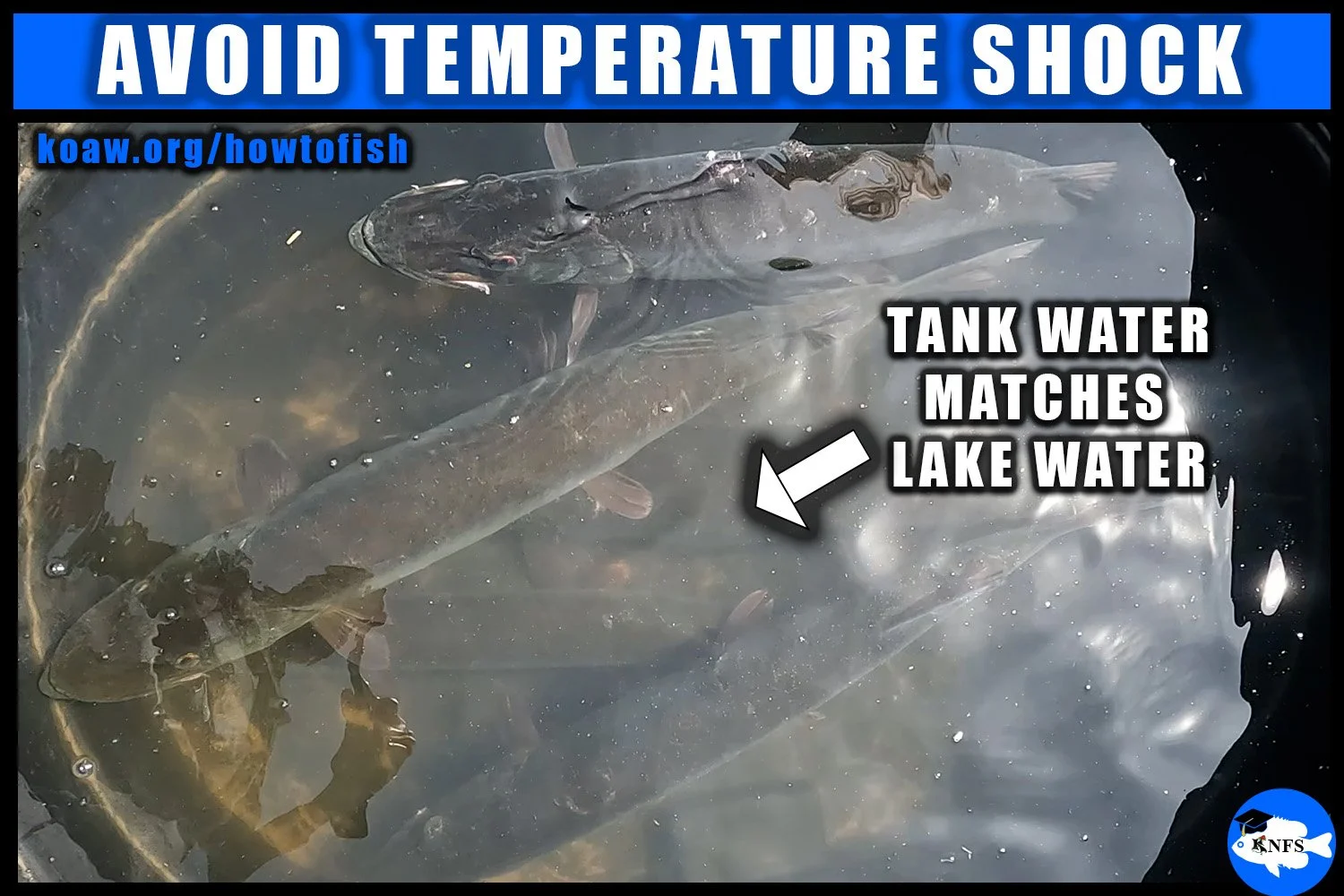
TEMPERATURE: Temperature shock results from a fish being quickly exposed to a new medium (such as a holding tank or placed on a hot deck) with a very different temperature. Temperature shock can immediately stun a fish, sometimes where that fish will not be able to recover. Even a handful degrees difference temperature can stun some species.
If measuring a fish on a board/flat surface, wet that surface first to cool it off and moisten it.
Generally, if moving a fish from one water source to the next, match the temperature as closely as possible to what the fish just came from.
AVOID DROPPING A FISH: As mentioned in the “Angler Safety” section above, a fish will flop about. A fish dropped on its head may suffer an injury that it will not be able to recovery from. Always attempt to hold a fish firmly, expecting that it will flop about, even if it seems calm.
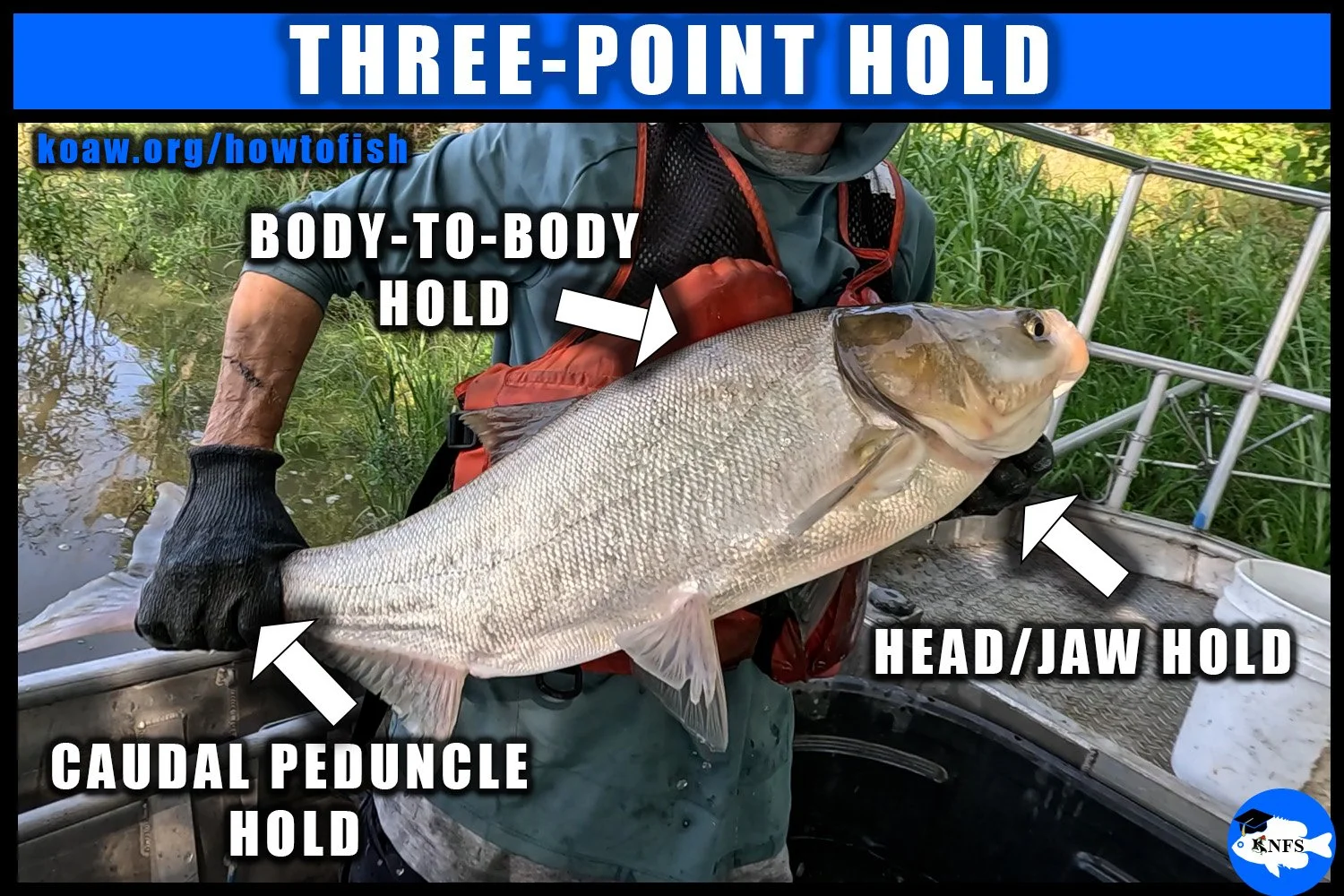
This large Silver Carp (Hypophthalmichthys molitrix) is being held with a three-point hold as Koaw gets ready to measure the fish for a survey.
A three-point hold for big fish is often helpful (see adjacent image).
1) One hand grips either around the belly or around the caudal peduncle (near the tail fin.)
2) One hand grips around the head or has a grip on the jaw.
3) Pull the fish into your body where the body-to-body pressure is the third point on the hold.
“Hold the fish like you’d hold a baby,” is what I often tell the undergraduate college students when I’m teaching them fisheries field work. Be gentle yet firm is the point I try and get across with this statement.
Barotrauma to fishes is a serious downside to angling fishes at deeper depths.
BAROTRAUMA: The term barotrauma refers to fish that is caught at deep depths and pulled to the surface where that fish is unable to balance the gases in the body, particularly the gases in their gas bladder, and therefore endure damage to internal organs. The gas bladder may burst and often the stomach is protruding from the mouth. Fish experiencing barotrauma, when released, can eventually balance their gases in time (assuming no fatal damage occurred), but they are vulnerable to predation. Some areas now require anglers fishing in certain areas to have a descending device to help treat barotrauma. See the Florida Fish and Wildlife Conservation Commission’s information on treating barotrauma.
A specimen of American Gizzard Shad (Dorosoma cepedianum) that is immediately put into appropriate water for photos.
SUSCEPTIBLE SPECIES: Some species do not do well after being handled for any duration. The American Gizzard Shad (Dorosoma cepedianum) and close relatives are ‘wimps’ to being handled. A number of trouts are also fairly fragile and can only endure the gentlest of treatments and exposure to environments outside what they were just pulled from.
TOOLS TO HELP THE ANGLER:
A landing net is also useful to edge on the side of the boat/dock to keep the fish in water while dehooking.
NET: A net is the first tool that an angler can use to safely control a fish.
A fish in a net can be kept in the water while dehooking a fish and preparing for a photo.
A rubber net is better than a more course threading material.
A rubber net lessens the amount of scales/mucus loss a fish will experience in a net.
Cradle Net - This is a modified net that is elongated and better suited at distributing the weight of large, elongated fish, such as Muskellunge (Esox masquinongy). Cradle nets are not often used to land a fish, but to keep the fish in water for measurements and then quick weight checks.
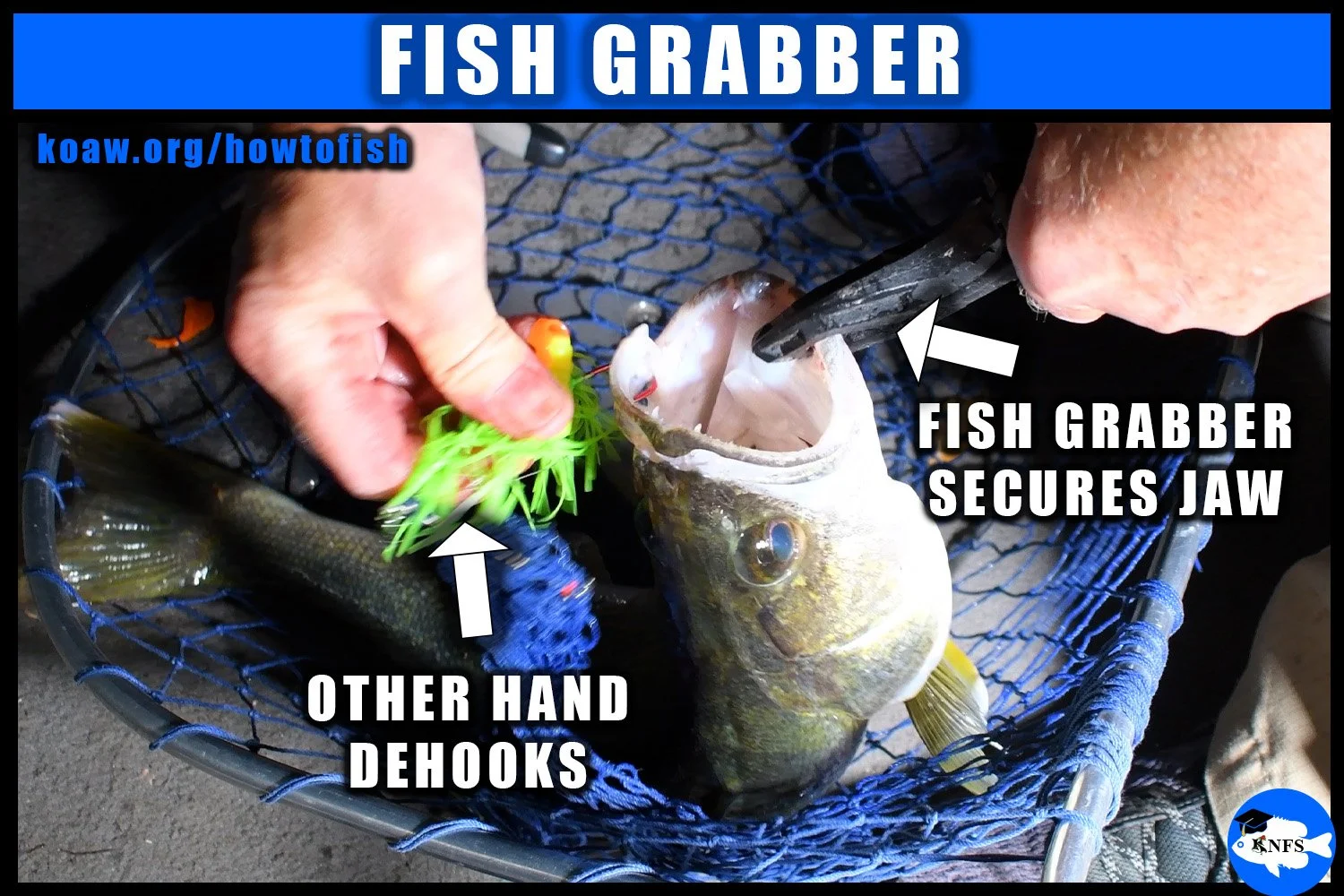
FISH GRABBER / FISH GRIPPER / MECHANICAL JAW HOLDING DEVICE
If using a fish gripper, there is a very high chance that damage to the tissues/bones will occur.
Only use if absolutely needed for angler safety.
A fish gripper may be helpful for medium to large species with very sharp teeth.
This tool is placed into a fish’s mouth so that the dermal tissue of the mouth is grabbed between the bones to help control the fish’s head.
This tool may also be helpful for weighing smaller to small-medium fishes.
If, with a fish gripper, attempting to vertically weigh a fish larger than ~5 lb / ~2.2 kg, severe damage to the tongue, tissues and/or jaw structure will almost assuredly happen.
Instead, weigh larger fishes on top of a scale and/or while the fish is being held in a cradle net or moistened bag meant for weighing fish.
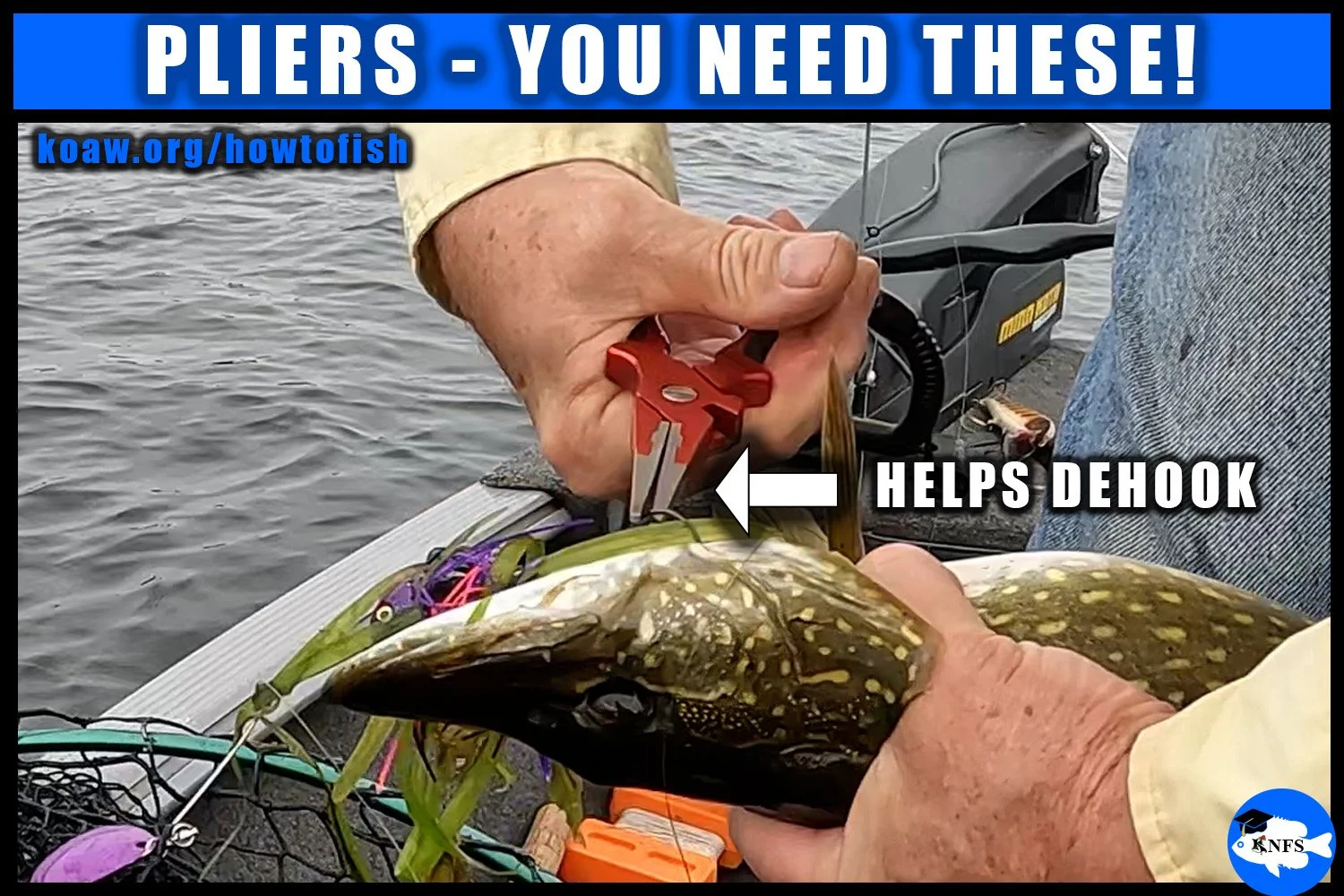
PLIERS / BOLT CUTTERS:
Pliers are the essential tool every angler should have.
Pliers help dehook the fish.
Bolt cutters are helpful for when I hook cannot be removed without severely damaging a fish’s jaw structure.
Simply cut a hook to remove the cut segments. (Hooks are fairly cheap and easy to replace on a rig.)
FISHING BUDDY:
A fishing buddy can help hold a fish while dehooking and even for photo preparations.
GAFF HOOK:
A gaff hook is a sharp tool used to snag and pull a fish into a vessel.
This tool should really only be used on a fish that will be harvested as it is harmful to a fish. There are few species that are caught, pierced with a gaff hook in certain soft tissue, and still released.