What we anglers attach to our fishing line is determined by the type of fishing we want to do as well as what types of fishes we want to catch. We’ll cover some basic items such as hooks, lures, other terminal tackle, and bait types.
The term “fishing tackle” is a somewhat ambiguous term.
For this guide, we will consider fishing tackle as any manufactured item used for recreational fishing (sportfishing.)
(The gear we discussed in the ‘Basic Gear’ section would also be considered as tackle.)
Terminal tackle describes any manufactured items used at or near the ‘terminal end’ of the line to assemble a rig that includes but is not limited to hooks, lures, swivels, snaps, weights, and floats.
STARTER RIGS: On an additional page, there will be a few suggestions of ‘starter packages’ that a new angler could purchase to easily rig to start fishing. We’ll then further discuss how to fish with these packages later in the guide.
HOOKS
Click to enlarge the Basic Features of a Hook Diagram.
This guide is focusing on rod-and-reel fishing that requires a fishhook as opposed to catching fish via other means, such as netting, trapping, and bowfishing. A vast amount of hook types exists on the market, each somewhat specialized for certain types of fishing.
The hook is, if all goes well, the connection point between the angler’s rig and the fish’s mouth.
The sharp point of a hook is meant to pierce the fish’s flesh between the bones (or cartilage) allowing for an angler to bring that fish in.
An angler almost always wants to ensure the point is sharp on their hooks—most manufactured hooks these days have points that stay sharp for a very long time. Pure stainless steel hooks will dull faster than high carbon steel hooks.
A long point on a hook may be used if an angler wants to lessen the likelihood of a fish spitting the hook, say from a strong jumping fish; that downside is that longer point (compared to a short point) on the hook will require a harder hookset to fully pierce the tissue of a fish’s mouth
The barb helps prevent the hook from coming back out before the fight is over.
Barbless hooks exist; these are used for various reasons, but are becoming prevalent in microfishing, or fishing for very small fishes, because not having a barb reduces damage to the fish and minimizes required handling of the fish.
The eye describes the portion of the hook that is tied to the line often by some sort of fishing knot—these come in various shapes.
The shank describes the elongated portion of the hook beneath the eye and before the bend. Some shanks are straight, some have bends, some even have other features, like barbs.
Typically, an angler targeting a fish with long sharp teeth needs to use a hook with a longer shank to avoid having the line or leader cut. Short shanks are less obvious within the bait and penetrate well in fishes with soft mouth tissue.
The bend of the hook describes the curved region connecting the shank and the point. Various bend shapes exist on the market to cater towards different fishing methods for different species.
The throat describes the distance between the bottom of the bend to tip of the point.
The gape, or gap, describes the distance between the tip of the point and the shank.
The simplest rig is just a hook and usually a bait, either live or processed.
A hook may have one or more points. A line may have more than one hook. Hooks may be paired with or ‘dressed’ with various manufactured materials like plastics, woods, feathers, and rubbers, that then are wholly described as a lure.
Click to enlarge. 1. Heavy wire with slightly turned down eye. (Size: #2, Make: Gamakatsu) 2. Large bend with turned up eye. (Size: #4, Make: Gamakatsu) 3. Barbless hook with relatively large, turned down eye. (Size: #26, Make: Gamakatsu) 4. Orange coated hook with turned up eye. (Size: #6, Make: Gamakatsu) 5. Specialized drop-shot hook with straight point. (Size: 1, Make: Standout) 6. Circle hook with straight eye. (Size: #7/0, Make: Gamakatsu) 7. Heavy wire treble hook. (Size: 4, Make: Mustad) 8. Fine wire, long shank, straight eye and point with bait keeper. (Size: 1, Make: Owner) 9. Bent, long shaft thick wire offset hook. (Size: 8/0, Make: Lunker City)
Fishhook diversity is tremendous.
Metal alloys, particularly high carbon steel and stainless steel, form the majority of hooks on the market.
With the vast array of styles and features on hooks, including the various sizes, dimensions, and coatings, most anyone could be scratching their head when browsing the hook section of a bait shop. Don’t worry— I’ll suggest some exact hook types to use for some easy rigs in the ‘Starter Rigs’ section.
Novice anglers should focus on assuring that the hook size, particularly the gap, or gape, is appropriate for the size of fish being targeted.
If the gap is too small, a fish will be less likely to be hooked as the hook may likely miss the hookset. If the gap is too big, the fish might not even be able to get the hook into the mouth.
Typically, for the smaller fishes, like common sunfishes, we’ll be using a hook size around #8, #6, or #4. For the black basses, like the ever-sought-after Largemouth Bass, we’ll be using a larger hook size, like a #1, #1/0, or #2/0 hook (where that 0 in the hook size is called aught, pronounced as ôt or like the ought in, ”I ought to pick the right hook size.” (A complete recommended hook-size chart is available for the common sunfishes.)
Wire size is another important consideration an angler must make about the hook they are using. Wire size describes the diameter, or weight, of the wire being used. There isn’t an industry standard set forth; a company often describes their hooks as standard, fine, or stout. A 1X Fine hook will describe the next narrower step down from standard; 2X Fine is two steps down. The same logic applies to stout, just that the hooks are thicker along the scale (1X Stout, 2x Stout, etc.).
You’ll notice that a #24 is a very small hook (used for microfishing) while as the number decreases (#22, #20, etc.) the hook size increases. However, starting at 1/0, the hook size will increase corresponding with the larger initial number (2/0, 3/0, 4/0, etc.).
LURES
A lure is typically an artificial (man-made) bait that usually has at least one attached hook. Most anglers will buy pre-manufactured lures while some anglers prefer constructing their own, such as with flies (a type of lightweight lure almost always tied by hand.) We’ll briefly discuss the most common types of fishing lures on the market. (The fishing techniques mentioned in this section will be discussed later in this guide.)
Spoons are simple in design and offer a lot of flash. Some have built in weed-guards (top right/bottom right) and some have built in rattles (bottommost).
SPOONS: Often of simple design, a spoon is just a solid piece of metal that usually wobbles around a central point. Spoons typically have a single trailing hook with either one or more points. Spoons sink rapidly and are often used for casting, jigging, and trolling. The heavy weight of spoons typically offers great casting distance.
Most spoons are of a shiny metal and create a lot of flash (light reflectance); this flash resembles the shimmering scales on a smaller fish and the wobble action resembles an injured fish. A predatory fish is drawn to an injured fish as the prey will be easier to catch.
In-line spinnerbaits (top three) typically have a blade revolving around a single, straight shaft. Safety-pin spinnerbaits have a bent structure where the blade typically revolves at one end, opposite the hook-end.
SPINNERBAITS: Spinnerbaits have at least one blade, often made of metal, that revolves in the water. A blade creates thump (noise) and flash to increase the lure’s noticeability to a fish. The two general types of spinnerbaits are the safety-pin design and the in-line design, where the latter is sometimes designated as a spinner rather than a spinnerbait. Spinnerbaits are most often used in casting and trolling. Single-hook safety-pin spinnerbaits are very effective in weedy waters albeit they’re not entirely weedless; larger blades pick up more weeds than smaller, thinner blades.
The theory is that the blade resembles a wounded baitfish being chased by a smaller fish (the rest of the lure’s body.) A predatory fish is more likely to target a ‘distracted’ fish.
An assortment of plugs. Bottom-left: A Rapala deep diving plug. Top-left: A jointed, adjustable diving depth (by eye attachment) plug. The near-top white-and-black Jitterbug is a surface plug that wiggles on the surface.
PLUGS: “Plugs” is an umbrella term for many lure types. These are hard-bodied lures, often made of balsa wood and/or plastics.
There are three main types of plugs: Diving, surface, and sinking.
Diving plugs typically float but have a large, angled lip so when the angler reels, the lure is taken to a deeper depth. These diving lures are often referred to as crankbaits.
Surface lures typically stay above or just under the surface.
Sinking lures will immediately sink and will continue to sink until the angler achieves the desired depth and begins to retrieve the lure.
Plugs are most often used for casting and trolling. Hard-bodied, fish-mimicking diving lures are the most popular plugs on the market.
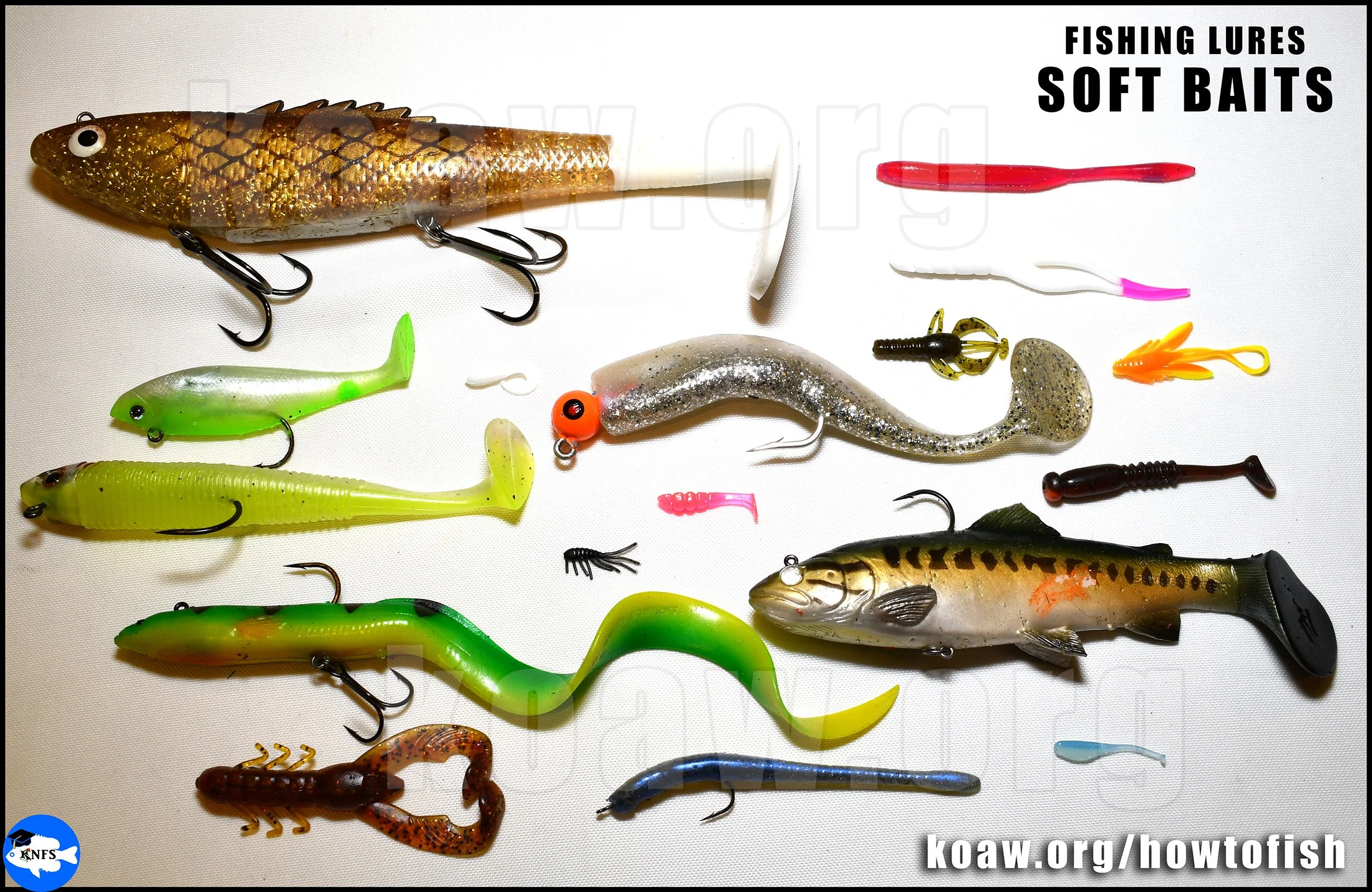
The top-left soft bait is molded over a central shaft. The central, white-bodied soft bait is on a jig. Worm mimics and creature baits are seen in the top-right.
SOFT BAITS: These soft-bodied lures have the appeal of a more natural movement in the water and are softer to the touch. Soft plastics are usually presented onto a single bare hook or onto a hook with a weighted jig head. Larger baits tend to have more hooks.
Soft baits may be molded over a central shaft where hooks dangle from connectors on the shaft. Often these baits are paired with scents, as these plastics are often better suited to absorb the odors. Soft plastics are usually mimicking long worms or various underwater animals. (There’s a subcategory of soft baits called creature baits.)
Soft baits are often used in jigging but may also be used for casting and trolling.
A few ‘naked’ jigs are seen in the upper-left corner. The bottom-right and top-right jigs have a weedless guard on the front. Many jigs are presented with soft baits attached.
JIGS: The basic jig is just a metal head attached to one hook. These jigs may be dressed in feathers, plastics, and other polymers. Soft baits, live baits, and scent baits are often attached to a jig to complete the presentation. Jigs are most often used in jigging but may also be used in casting and trolling situations.
An assortment of flies. The middle, rightmost flies are floating topwater poppers that some fly-fishing anglers may not consider as flies because they are not entirely handmade.
FLIES: Flies are a generic term describing lightweight lures that are used with light line and most often on fly fishing rods.
Flies are not strictly confined to use by fly fishing rods and reels.
Flies are typically small but may also be very large (just under a foot in length.) A fly is often constructed as a small hook that has been wrapped in thread, feathers, and other lightweight materials to resemble an aquatic insect. Sometimes a bead of copper or other material will form the head of the fly to allow the lure to sink more readily. Generally, flies can be thought of in two general categories, floating and sinking. Where a number of subcategories exist as well.
Here are some other bait options that may be attached either to a hook or a lure:
Live bait - Any live animal attached to hook as a bait. Keep in mind that when buying live bait, you’ll need to keep it alive! Earthworms and leeches should be refrigerated, and other live fish need dissolved oxygen, adequate temperature, and frequent water changes.
Example: Small Golden Shiner (a fish) is often used as a bait to catch crappies.
Example: Earthworms are used to catch a variety of species.
Cut bait - Any cut portion of an animal attached to a hook as a bait; (often considered as a subcategory of live bait.)
Example: Cut sections of frozen mackerels (various fish species) are often used in saltwater fishing.
Example: Cut pieces of chicken are often used to catch catfishes.
Scent bait - Either an artificial or organic bait that emits chemicals that can be detected by the smelling and tasting sensory systems of a fish. Most processed baits are moldable to form around and adhere to a structure on a rig. In essence, any bait emitting a scent could be considered a scent bait. Anglers often add manufactured gels and or oily liquids to give off powerful scents, such as for carp fishing.
Example: Artificial leeches are often infused with strong, oily substances to attract fish.
Example: Boilies are usually homemade boiled dough-like concoctions usually at least containing flour, egg, and various other ingredients.
Click the image to enlarge.
OTHER TERMINAL TACKLE
Here are other common pieces of terminal tackle.
Click the image to enlarge. 1. Tear drop sinker with twisted barrel swivel. 2. Bank sinker. 3. Bottom bouncer sinker. 4. Egg sinker. 5. Pyramid sinker with molded eye. 6. Removeable lead split shots. 7. Egg sinker. 8. Bullet sinkers. 9. Removeable tin split shots.
SNAPS: A snap is a lockable device that is able to connect two or more objects of tackle such as fishing line, split rings, weights, swivels, and lures. Snaps come in various sizes and designs. Snaps are sometimes desired to enhance the performance of certain lures.
SWIVELS: A swivel is a connector device that has at least one freely rotatable unit meant to reduce line twist. A swivel is often manufactured with a connected snap, where these are called “snap-swivels”. Some artificial lures, like plugs, require a swivel between the lure-line connection to maintain performance. However, snap-swivels may hinder the performance of many lures, simply just by the added weight.
SPLIT-RINGS: Split rings are circular pieces of metal used to connect various bits of tackle. A fishing split-ring is similar to that ring holding your car keys as it allows adding or removing items between the compressed metal. Split rings are often found on lures so that changing hooks is easily done.
SINKER WEIGHTS: Weights for fishing come in many types and have many purposes. Weights may be used to entirely sink a rig to the bottom or to help sink a rig to a certain depth. Certain sinker weights will be fixed on a rig, like a split shot, or free-sliding, like a bullet sinker.
FLOATS
An assortment of floats.
Floats are less dense than water and able to assist a rig to stay, and possibly perform a certain way, at a desired depth, be it at the surface, bottom, or some depth between.
Some floats can also act as a ‘bite indicator’, allowing an angler to visually see when a fish is interacting with a rig. The commonly utilized red-and-white bobber is a float that stays at the surface keeping the bait suspended at a certain depth while also being a bite indicator. Floats are typically made of cork, foam, and other plastics. A broad variety of floats exist on the market, many specialized for certain types of fishing.
Rigging a float often requires the addition of one or more sinker weights along the line to achieve a desired depth and/or help maintain a certain action to the rig.
This addition and adjustment of weight to a float-rig is called shotting.
Correctly shotting a rig is important so that the float performs the desired role.