A Pumpkinseed (Lepomis gibbosus) is held for a quick photo after being caught on rod-and-reel.
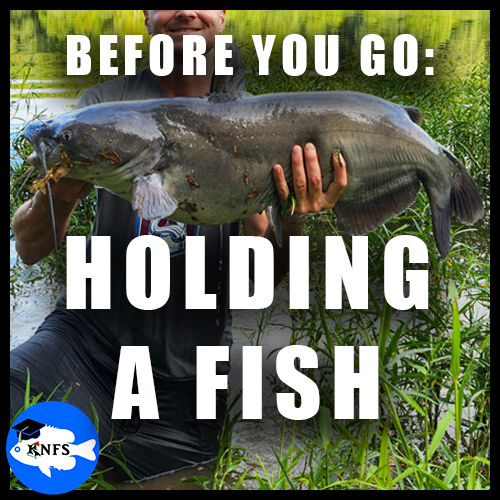
The Common Sunfishes (Lepomis) have species that are excellent for new anglers to target for developing fishing skills, including the important skill of how to properly hold a fish.
All species in this genus can be held with the methods described on this page.
The Bluegill (Lepomis macrochirus) and the Green Sunfish (Lepomis cyanellus) are ubiquitous across much of the United States and parts of Canada. Species in this genus range from very small, where the Bantam Sunfish (Lepomis symmetricus) only reaches max sizes around 4 in (100 mm), to medium, where the Redear Sunfish (Lepomis microlophus) can reach sizes around 16 in (400 mm).
Many other species outside of the genus can be held with the methods described on this page including but not limited to:
Rock Bass, Shadow Bass, Roanoke Bass, & Ozark Bass (Ambloplites)
Black Crappie and White Crappie (Pomoxis)
Mud Sunfish (Acantharchus)
Bluespotted Sunfish, Banded Sunfish, and Blackbanded Sunfish (Enneacanthus)
Disclaimer: Hold and process fish at your own risk. There is always potential risk of incurring harm to your body when fishing and handling fish, even if all precautions are followed.
DO COMMON SUNFISHES HAVE TEETH?
Shows how small the teeth are in the relatively large mouth of the Warmouth. Note this image does NOT show all the teeth in the mouth of this fish.
Yes, the members of Lepomis do have very small often sharp teeth of various types in different places within the mouth.
The most obvious teeth are present on the premaxillary and dentary (the outermost top and bottom part of the jaw bearing teeth.) These teeth in the mouth are often small, thin, and either fully pointed or curved.
Warmouth (L. gulosus) and some populations of Green Sunfish (L. cyanellus) have tooth patches on the tongue—these patches really feel like low-grit sandpaper. Some species will have teeth on the palantine and varying forms of teeth on the gill arches.
‘Lipping’ a common sunfish by the mouth, if the fish even has a large enough mouth, is possible—yet not recommended to a novice angler unless the angler wears gloves.
The teeth, even though very small, are sharp and can cut an angler’s fingers if handled improperly.
An angler risks being cut by the teeth if firmly grasping and/or rubbing the teeth instead holding onto the soft fleshy tissue within the mouth. Of course, most angler’s fingers are fairly callused and resistant to being harmed from these small teeth.
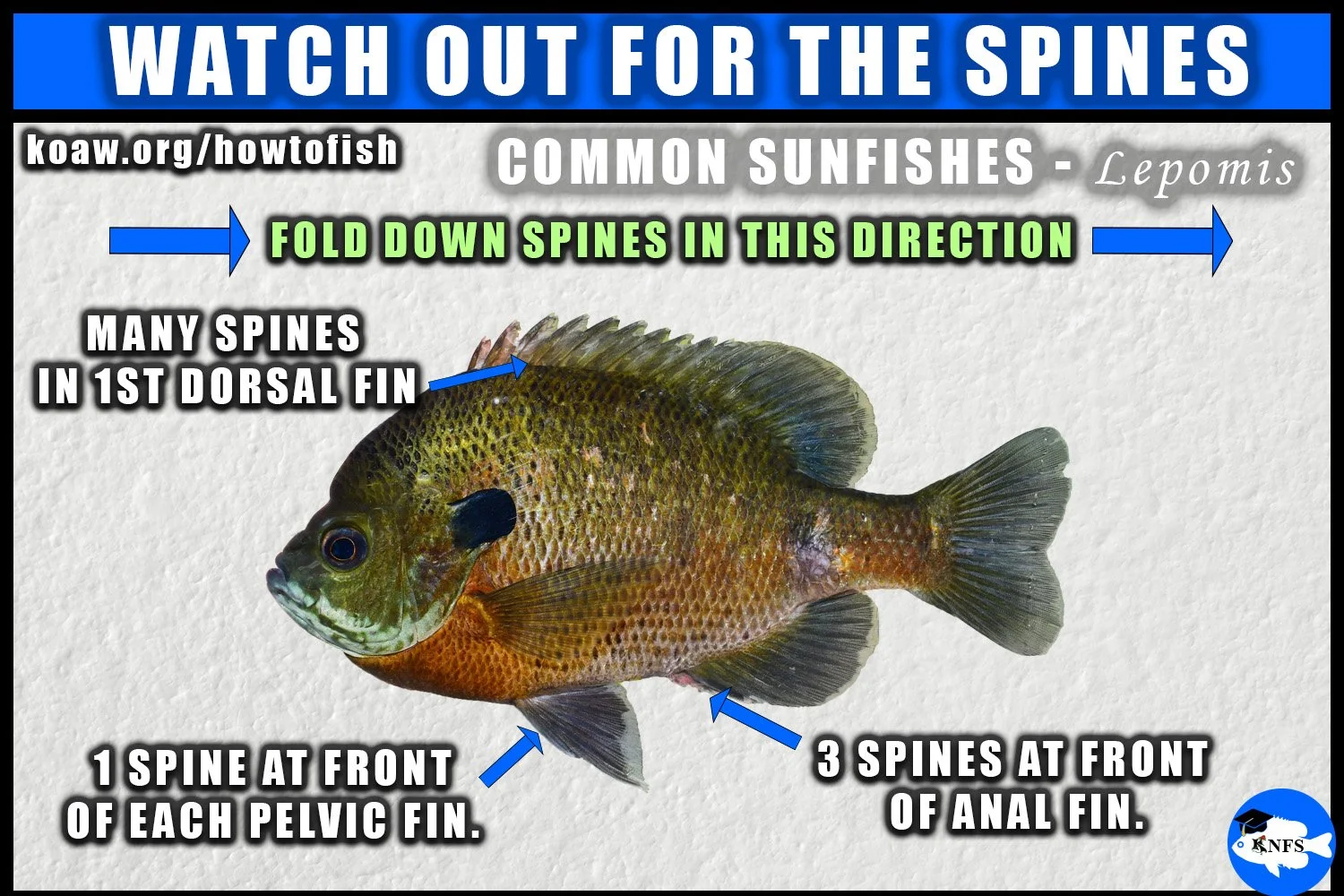
A male Bluegill (Lepomis macrochirus) demonstrates the similar fin spine arrangement for all members of the genus.
DO COMMON SUNFISHES HAVE SHARP SPINES?
Yes, the members of Lepomis have sharp spines in the first dorsal fin, the pelvic fins, and the anal fin.
An angler needs to fold these fins downward starting from the head direction and moving towards the tail in order to collapse the fins and prevent them from ‘sticking’ the angler.
If handled incorrectly, these spines in the fins could pierce the skin of an angler’s hand.
DO COMMON SUNFISHES HAVE SHARP SCALES?
Yes and no; the members of Lepomis have many ctenoid scales on the body, meaning that there are small spiny projections posteriorly on these scales.
However, these scales are not really that sharp relative to other species with ctenoid scales of different formation, like the ctenoid scales on Walleye. Most anglers hold common sunfishes without wearing gloves and do not sustain any damage to the hands.
The scales of a common sunfish will most likely not damage an angler’s hand unless that angler forcefully rubs the scales from the tail towards the head.
Younger common sunfishes have less-developed ctenoid scales than older specimens, meaning that these younger fish will be ‘softer’ to the touch. There are varying amounts of cycloid scales, such as on the opercle (gill plate); cycloid scales are often smoother and more roundly than ctenoid scales.
Always try to wet hands and gloves before handling a fish to help minimize the amount of mucous membrane removed from the fish when handling.
TYPICAL HOLD METHOD - HAND GRAB
The following holding method is very effective at quickly controlling the fish, dehooking the fish, and moving the fish while also avoiding getting punctured by any of the spines in the fins. This method works for the majority of small fishes caught by anglers.
HOLD METHOD - LIP & SUPPORT
The following hold will work particularly well for Green Sunfish and Warmouth as both of these species have very large mouths, even when young and/or at small sizes.
LIPPING A COMMON SUNFISH
Lipping a common sunfish is essentially the exact same method as lipping a black bass, like the Largemouth Bass, as was discussed on the “How to Hold Bass” page.
The angler’s thumb is extending over the teeth, not on the teeth of the lower jaw.
The thumb is not exactly central, but slightly off to one side touching the soft fleshy tissue.
The thumb applies pressure firmly against the soft tissue and against the index finger.
SUPPORT A SIDEWAYS HELD FISH
Larger fish, like the Warmouth in the photo above, require a bit of extra support on their breast and/or belly to help distribute the weight.
This helps prevent excess stress on the jaw and spine.