Ace, a frequent KNFS community contributor, holds a sizeable Largemouth Bass (Micropterus nigricans).
The genus of Micropterus, the black basses, contains fishes that are frequently encountered by freshwater anglers. The Largemouth Bass (M. nigricans) and the Smallmouth Bass (M. dolomieu) are two examples of fishes in this genus that anglers strive to catch. These fishes put up quality fights, are fairly hardy, and may attain sizes over 20 lb (9 kg), though encountering specimens of that size is extremely rare.
Disclaimer: Hold and process fish at your own risk. There is always potential risk of incurring harm to your body when fishing and handling fish, even if all precautions are followed.
DO BLACK BASSES HAVE TEETH?
Yes, the members of Micropterus do have small teeth in various places within the mouth, of which, mostly feel like low-grit sandpaper.
The most obvious teeth are present on the premaxillary and dentary, of which, are mostly small, thin, numerous, and pointed.
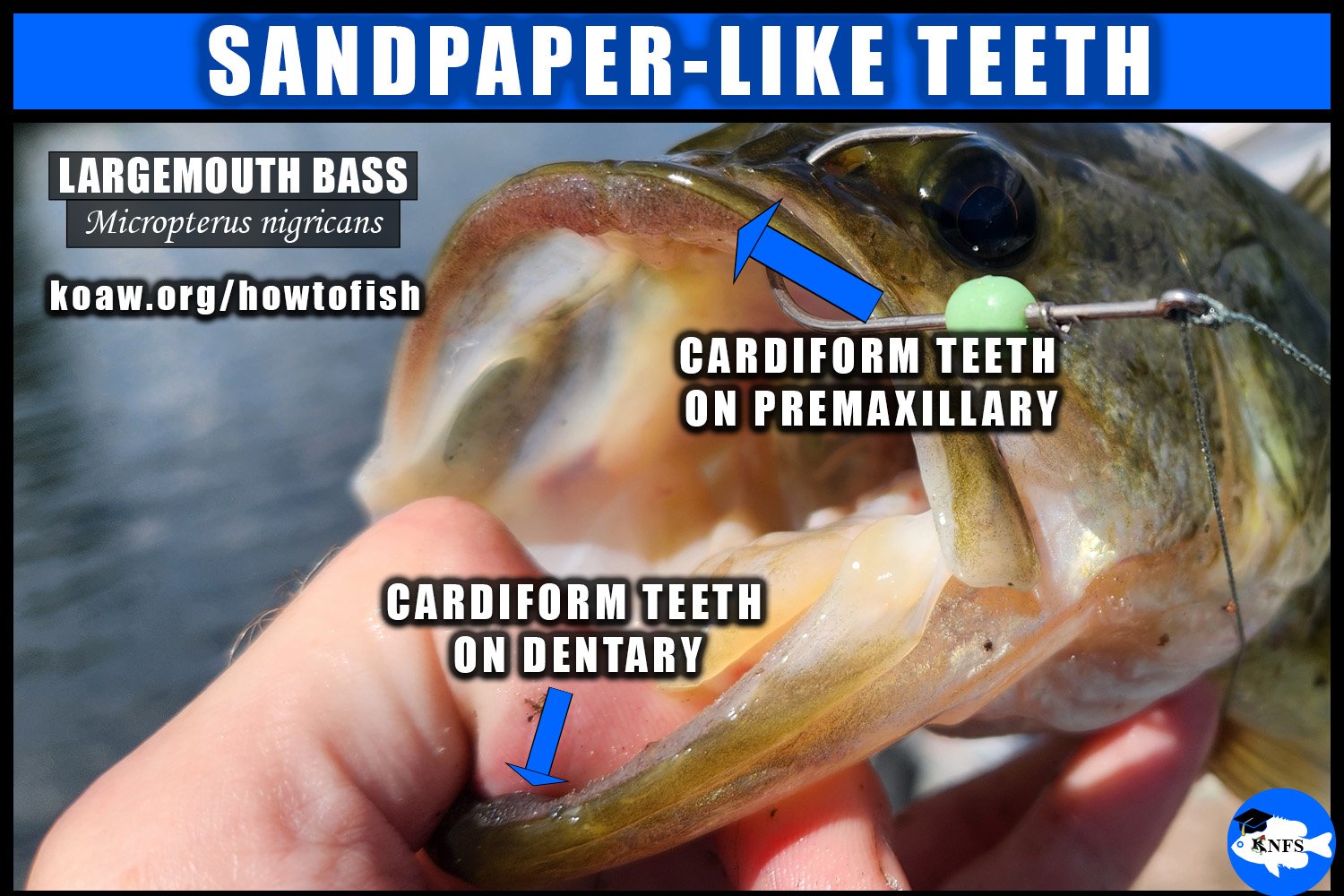
The sandpaper-like teeth of the Largemouth Bass are very unlikely to cut an angler’s hand if the fish is held correctly.
There exists a secondary jaw mechanism in the back of a bass’s mouth where the tooth plates on the pharyngeal bones assist in grabbing and crushing food sources. An angler need not worry about these tooth plates unless planning on jamming fingers deep into the fish’s mouth.
Teeth also are present on structures of the palatine and on the ectopterygoid as well as tooth plates existing on the pharyngeal bones. Some members of the black basses even have tooth patches on the tongue (glossohyal bone).
There are no extremely long and sharp teeth in the mouth of any member of the black basses.
All black basses have a similar spine arrangement as is seen in the image.
DO BLACK BASSES HAVE SHARP SPINES?
Yes, the members of Micropterus have sharp spines in the first dorsal fin, the pelvic fins, and the anal fin.
An angler needs to fold these fins downward starting from the head direction and moving towards the tail in order to collapse the fins and prevent them from ‘sticking’ the angler.
If handled incorrectly, these spines could pierce the skin of an angler’s hand.
CAN I ‘LIP’ A BASS SAFELY?
Yes and no—let’s go through this one in more detail.
Lipping describes a fish-holding method by an angler that involves using the angler’s thumb and index finger to pinch the dermal and/or cartilaginous tissue around the dentary bone (front-bottom bone of the jaw) of a fish to hold and/or lift the fish.
Angler’s frequently hold members of the black basses with this lipping method without wearing any protective gloves.
So yes, lipping, or holding a bass by the mouth, is safe if done correctly.
However, the teeth in a black bass’s mouth are still able to cut an angler’s fingers if held incorrectly and/or the angler has more delicate skin.
Avoid rubbing/pulling fingers across the teeth, especially if the fingers are inside the fish’s mouth and coming out.
Larger specimens will have larger teeth.
Even a small 1-2 lb bass should have some of the full body weight supported via the breast or belly when lifting sideways to prevent bodily damage.
Safety for the bass: Small specimens (~less than 3 lb / 1.4 kg) of black basses may be vertically lifted by the mouth via the lipping method without doing any significant damage to the jaw (though damage may still occur, especially if the fish is struggling.)
Vertically lifting while only supporting the lower jaw should maintain a firm grasp and attempt not to bend the fish so as to bend the spine too much.
If rotating the fish more sideways, supporting the fish’s breast or belly is encouraged so as to prevent spinal damage.
Larger specimens may still be lipped by the mouth, but the angler also needs to support more of the fish’s weight by holding the breast or belly, especially if rotating the fish and causing bending of the fish’s spine.
Always try to wet hands and gloves before handling a fish to help minimize the amount of mucous membrane removed from the fish when handling.
The image shows a fairly conservative way to handle a small black bass that has recently been caught on rod and reel. Most anglers are not this conservative when handling a small black bass.
HOLDING LARGE BLACK BASS:
Holding larger members of black basses should require a bit more attention to supporting and distributing evenly the weight of the fish.
Larger fish have more weight—we know that.
If only holding by the jaw, the chances of damaging the bodily parts of the fish increases, especially if the fish squirms.
Even vertically lifting a large black bass only by the lower jaw is strenuous on the dermal tissue, cartilage, and bones of the jaw.
The bones can easily break if a heavy fish flails around.
If rotating the fish to a more sideways position, there is increased risk of damaging the vertebrae of the fish if not also supporting more weight on the back end of the fish to prevent the fish’s spinal column from bending.
The larger the fish, the higher the risk of damaging the spine and/or breaking the jaw.
Shows a conservative method for holding medium to large specimens of the black basses (Micropterus). This method includes how to weigh and measure a bass.

An example of holding a large bass firmly yet gently. The full weight of this Smallmouth Bass is distributed so that the vertebrae do not experience damage because of awkward bending.
In the nearby step-by-step image, a Smallmouth Bass (Micropterus dolomieu) that is ~6 lb (~2.7 kg) and ~20 in (~51 cm) is being held more conservatively than the smaller-sized bass in the first step-by-step image.
Larger bass should be dehooked while still in the water.
One hand lips the bass while the other hand dehooks the rig from the fish’s mouth.
The water is supporting some of the fish’s weight, of which, is better for the fish.
Begin supporting the weight of the fish at 2 spots when lifting the fish out of the water.
Supporting the breast, belly, and/or caudal peduncle (the tail region) will distribute the weight so that all of the pressure is not focused on the fish’s jaw.
Always hold the fish firmly yet gently.
If you hold the fish like you’d hold a human baby, you’ll take care to hold it firm enough to not let it fall when the fish squirms and yet gentle enough so as not to damage the fish with excessive grip pressure.
The grip pressure between your thumb, the fish’s dermal tissue, and the index finger can be fairly sturdy.
Measure the fish on a wet, cool, and non-abrasive surface.
A weigh bag, as is seen in the step-by-step image, is great to measure the fish if a proper measuring board is not available.
If no measuring board is available and the fish must be set down to measure:
If on a dock, carpeted boat, or shoreline, find the softest area and splash water to cool and soften the area before placing the fish down to measure.
The hot aluminum hull of a boat will need to be cooled with a few extra splashes of water before placing down the fish.
Weigh the fish in a wet, cool, and non-abrasive surface.
Again, a weigh bag is designed to adequately help the angler weigh the fish without damaging the fish.
Fish grippers attached to the hook of a scale will work—however, there is almost a guarantee that the fish’s mouth bones, tissue, and/or cartilage will be damaged in this process.
Ideally, attempt to get the fish back into water in 30 seconds or less.
If harvesting the fish, the meat is better if the fish is less stressed.
If keeping the fish in a livewell (a container for holding fish and water) see the recommended procedures below.
When putting the fish back into the water, maintain hold of the lower jaw as well as another spot along the fish’s body to distribute the weight.
When the fish is in the water, release the hold on the body first, then release the hold on the jaw.
LIVEWELL RECOMMENDATIONS FOR BLACK BASSES
If keeping the fish in a livewell attempt to:
Add ice to the water to cool the livewell water ~ 5-10 ˚F less than the water the fish was pulled from.
Cooling the water is not often necessary for winter fishing when the water and air temperature are already quite cool.
Add some unionized salt (or a premixed brand made for freshwater fishing) at roughly a mixture of 1 cup of salt to 15 gallons of water.
Freshwater fish under stress have a hard time keeping in salts—a bit of added salt to the water helps them regulate necessary processes.
Most importantly, ensure that the water is oxygenated.
Warmer water holds less oxygen than cooler water.
Ideally, the dissolved oxygen (DO) levels would be around 8 mg/L (ppm).
An aerator/bubbler is one way of adding movement and some DO to the water; the finer the bubbles, the more likely the water will gain DO.
Most DO is gained by the water via the surface area exchange with the atmosphere; hence why a flow making device in a livewell exposed to the atmosphere is beneficial.
Most anglers do not have instruments to measure DO as this equipment is pricey.
Over-oxygenating the water is possible but not too much of threat for fish that will be processed within the day.
Finally, for a livewell that is going to be crammed with fish, an ammonia reducer chemical will aid in breaking down toxic nitrogenous waste. Texas Parks and Wildlife recommends water conditioners containing ClorAM-X®.
Fish release nitrogenous wastes in the form of ammonia (NH3) and ammonium (NH4+) via their gills and urine; these wastes will build up in a livewell if not treated and/or fresh water is not exchanged.
If using an ammonia reducer chemical agent AND the water is able to stay cool AND the water is able to stay oxygenated, then water changes are not really necessary.
Water changes are necessary if either nitrogenous wastes, dissolved oxygen, or temperature cannot be maintained.