On this page we’ll go over how to construct this rig as well as how to play, or fish, this rig.
To tie this rig, you’ll need the following:
From the items that were covered on the ‘Starter Rigs’ page, you should have the following items:
a spinnerbait (safety-pin or in-line)
a snap-swivel (if spinnerbait has closed eye, not R-eye)
From what was covered on the ‘Basic Gear’ page, you should have the following items:
a reel on a rod
fishing line spooled onto that reel. (See KNFS YouTube video on how to spool line onto a baitcaster / spinning reel here.)
line cutters
WHAT FISHES WILL THIS RIG CATCH?
This rig can be fished in freshwater and saltwater.
Multispecies rig (catches many different species.)
This rig is meant to catch predatory fishes that eat other animals, particularly other fishes.
Freshwater fishes often caught with this rig include any of the black basses, common sunfishes, pikes, Walleye, many salmonids, bowfins, crappies, and so many more.
Saltwater fishes often caught with this rig include Red Drum, any of the snooks, many salmonids and many more species.
This rig does well…
being cast from shoreline/boat (discussed below)
Single-bladed safety-pin spinnerbaits can be played through light vegetation though this rig is not weedless.
Thinner blades (like willow blades) will snag fewer weeds than thicker blades (like Colorado blades).
being trolled from a boat.
Can target various depths depending on speed of vessel while trolling.
Shows a Largemouth Bass (Micropterus nigricans) caught on a single-blade single-hook safety-pin spinnerbait.
This rig does not do well…
being cast into very thick vegetation (even the single-bladed safety-pin spinnerbaits)
Though the single-bladed safety-pin spinnerbaits can be played through plants, it will still snag plants.
Spinnerbaits with treble hooks (hooks with 3 points) cannot be played into any sort of structure without snagging.
Click to watch video.
Step 1 - PREPARE THE LINE
If the reel is not yet spooled, see the adjacent video to spool the reel.
Ensure that the line is threaded correctly through the level wind guide on the baitcaster, or for a spinning reel, correctly underneath the bail.
Ensure that the line is threaded through each eyelet along the shaft of the rod.
Step 2 - TIE A KNOT
ATTACH SPINNERBAIT TO LINE (R-EYE SAFETY-PIN SPINNERBAIT) :
2.1 The line will be attached directly to the spinnerbait. (See the instructions below for tying a knot.)
OR
ATTACH SPINNERBAIT TO LINE (CLOSED-EYE SPINNERBAIT) :
The line can be tied directly to the spinnerbait, however, most spinnerbaits with the closed-eye will perform better if using a snap-swivel between the line and spinnerbait.
2.1 Attach the line to the closed-eye of the swivel on the snap-swivel. (See the instructions below for tying a knot.)
2.2 Attach the snap to the closed-eye of the spinnerbait.
HOW TO TIE A KNOT:
The adjacent video will show how to tie one of the simplest, strongest terminal knots in fishing, the Palomar Knot.
Tips for mono / fluoro line:
Click to enlarge.
If attempting the Palomar Knot and you chose to use thicker line and are unable to easily thread in the folded line through the eye, simply just thread in the tag end (cut end) first, pull out some line, and thread it through again. If the line still doesn’t fit through the eyelet of the hook, then you’ll need to use a different knot that doesn’t require the double eyelet threading, like the San Diego Jam Knot.
STEP 3 - CAST THE RIG
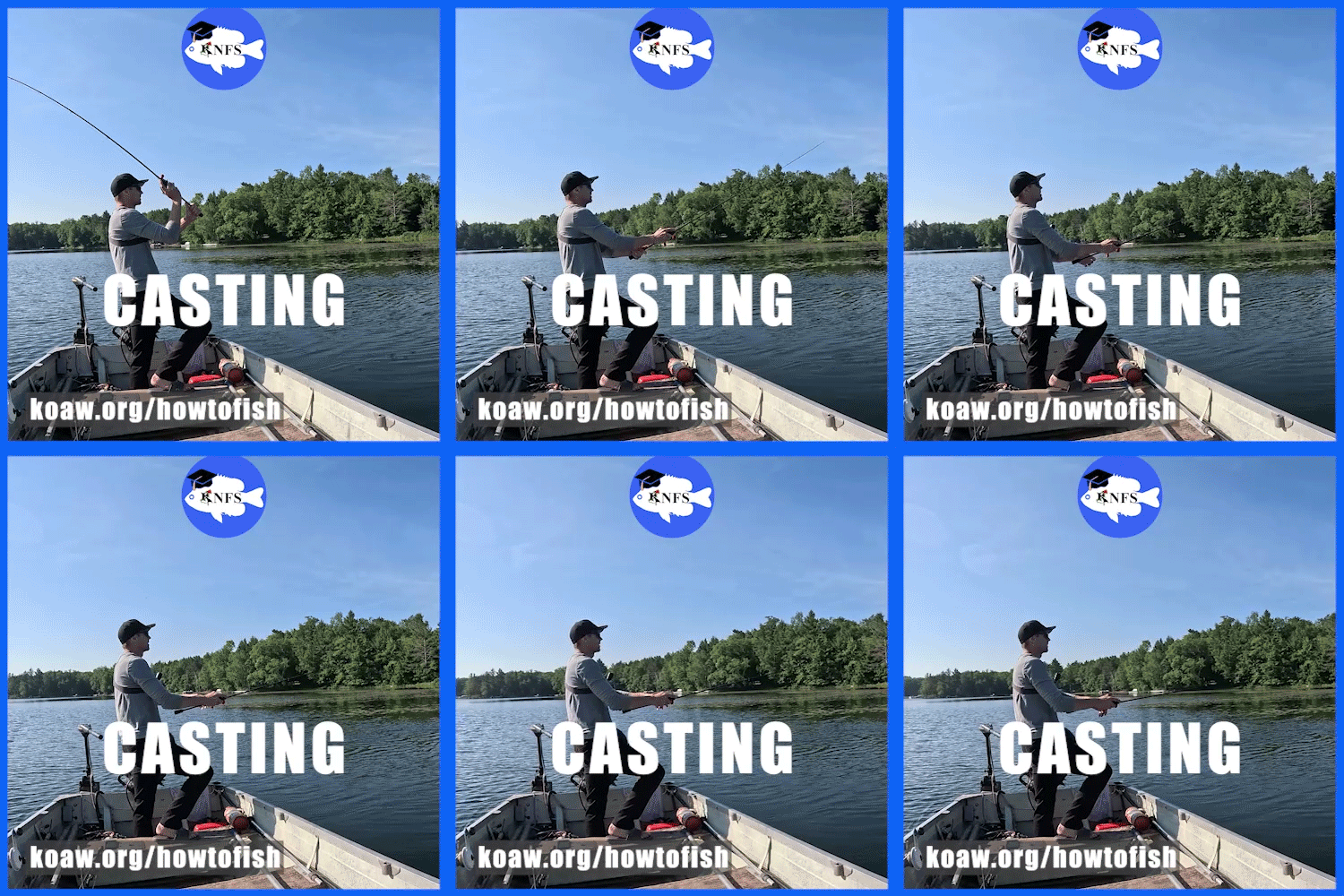
Click here if needing to learn how to use a rod and reel.
3.1 KNOW BASIC CASTING MECHANICS:
I prepared a tutorial page on basic casting mechanics for the three rod and reel combinations most frequently used. Refresh on this casting mechanics material if needed.
This rig can be playing well with a spinning, spincast, and baitcaster rod and reel.
A baitcaster should only be used if the angler has mastered this difficult rod/reel.
STEP 4 - PLAYING THE RIG:
Playing, finessing, working, and other terms are used to describe the actions an angler can give to the rig to put the rig into a certain position and entice a fish to strike. Different rigs have different performance capabilities; some rigs are meant to be finessed while others are not.
PLAY STYLE #1 - The Straight Retrieval
Any spinnerbait should work fantastic with a simple cranking of the handle.
TIPS TO REMEMBER:
SLOW-DEEP: Slow retrievals (cranking the handle slowly) will have the lure deeper in the water.
This may be beneficial in open water situations where the rig should be presented deeper.
This may not be beneficial if there are snags like plants and woody structure.
FAST-HIGH: Fast retrievals (cranking the handle rapidly) will have the lure higher in the water, nearer the surface.
This is usually beneficial if needing to stay above sunken plant beds and other structure.
Too fast of a retrieval may limit many species from being able to successfully strike the rig.
Step 1: Pick a spot and cast towards it.
Step 2: Once the lure hits the water, allow it to sink for a second.
Be sure to remove slack from the line that exists from the cast by either cranking the reel handle a little or lifting the rod tip.
Step 3: Begin cranking the handle to retrieve the line.
Step 4: While still cranking, lower the rod tip so that it faces the water. (This always for easier hooksets.)
Crank at a speed that allows your lure to be at the desired depth.
Step 5: Set the hook fairly hard if a fish strikes.
Step 6: If no fish strikes, reset and cast again!
PLAY STYLE #2 - Adding Drops to Retrieval
Drops implies allowing the rig to sink, straight down. Some spinnerbaits have very good action when they drop, as in, the blades will slowly flutter, giving off plenty of flash and thump. This drop action is less intimidating than the straight retrieval and may entice that fish following your lure to finally strike!
Some spinnerbaits have terrible action when they drop—like many in-line spinnerbaits. You can easily test this by dropping your rig in the water right in front of you to determine if the blades spin when the rig falls with no resistance from your line/rod.
A drop is very simple to do and can be done at any stage of the cast (beginning, middle, and end.)
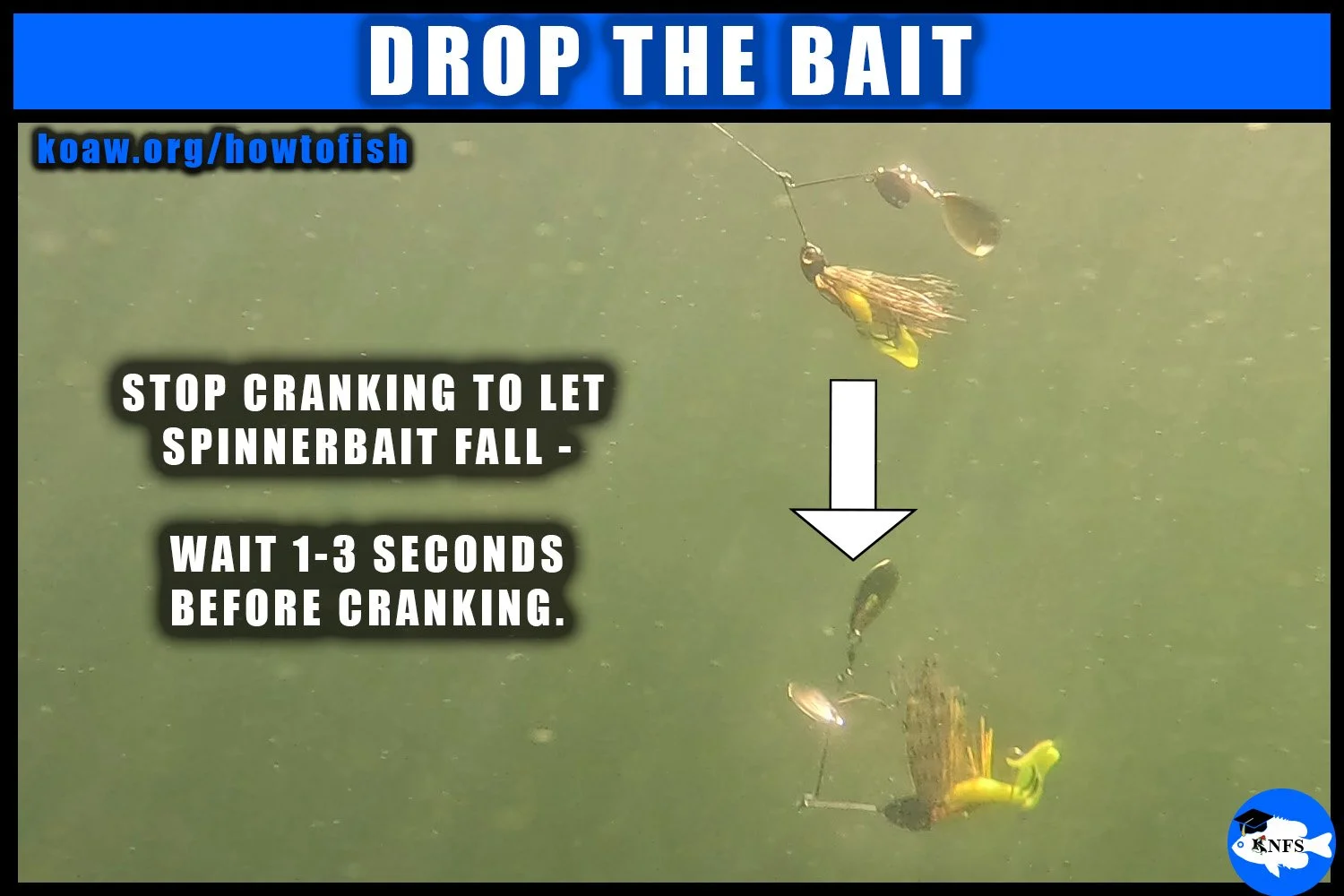
Step 1: While cranking the handle, slowly bring your rod tip higher—about 3 ft (1 m).
Step 2: Stop cranking the handle
This will cause the rig to sink.
Step 3: Lower the rod tip at the same speed your rig is dropping.
If the rod tip lowers too fast, slack will be seen.
If the rod tip lowers too slow, the rig will be slowed on the drop and might not have the blades spin properly.
Step 4: Make sure to keep slack out of the line.
Step 5: Set the hook fairly hard if a fish strikes.
Step 6: If no fish strikes, resuming cranking until the next drop opportunity.
Dropping 1 or 2 times during a cast is recommended.
PLAY STYLE #3 - Waterskiing Plants (Advanced skill)
Step 1: Prepare to cast over vegetation that is not too thick.
Lilly pads are ideal to waterski over.
Step 2: Cast the lure and keep the rod tip fairly high before the lure hits the water.
Make sure not to leave the rod tip too high. If a fish strikes the second the lure hits the water, a hookset is necessary.
Step 3: The moments before the lure hits the water, stop the spool by either cranking the handle (spinning/spincast reel) or thumb braking (baitcaster).
Step 4: The final moment before the lure hits the water, begin cranking the handle.
Step 5: When the lure hits the water, crank the handle rapidly.
The idea is to stay above plants and on the very tip-top of the water.
It is hard to get a fish strike to hit the lure here because the lure is moving fast and the plants impede visibility as well as striking lanes for the fish.
If a fish does strike, and you feel a tug back, set the hook.
Step 6: Crank the handle until the plants/structure ends, then immediately drop the lure.
Most strikes happen on this drop, at the edge of the structure.
Set the hook hard if a fish strikes.
Step 7: Continue with the retrieval and reset if no fish strikes.