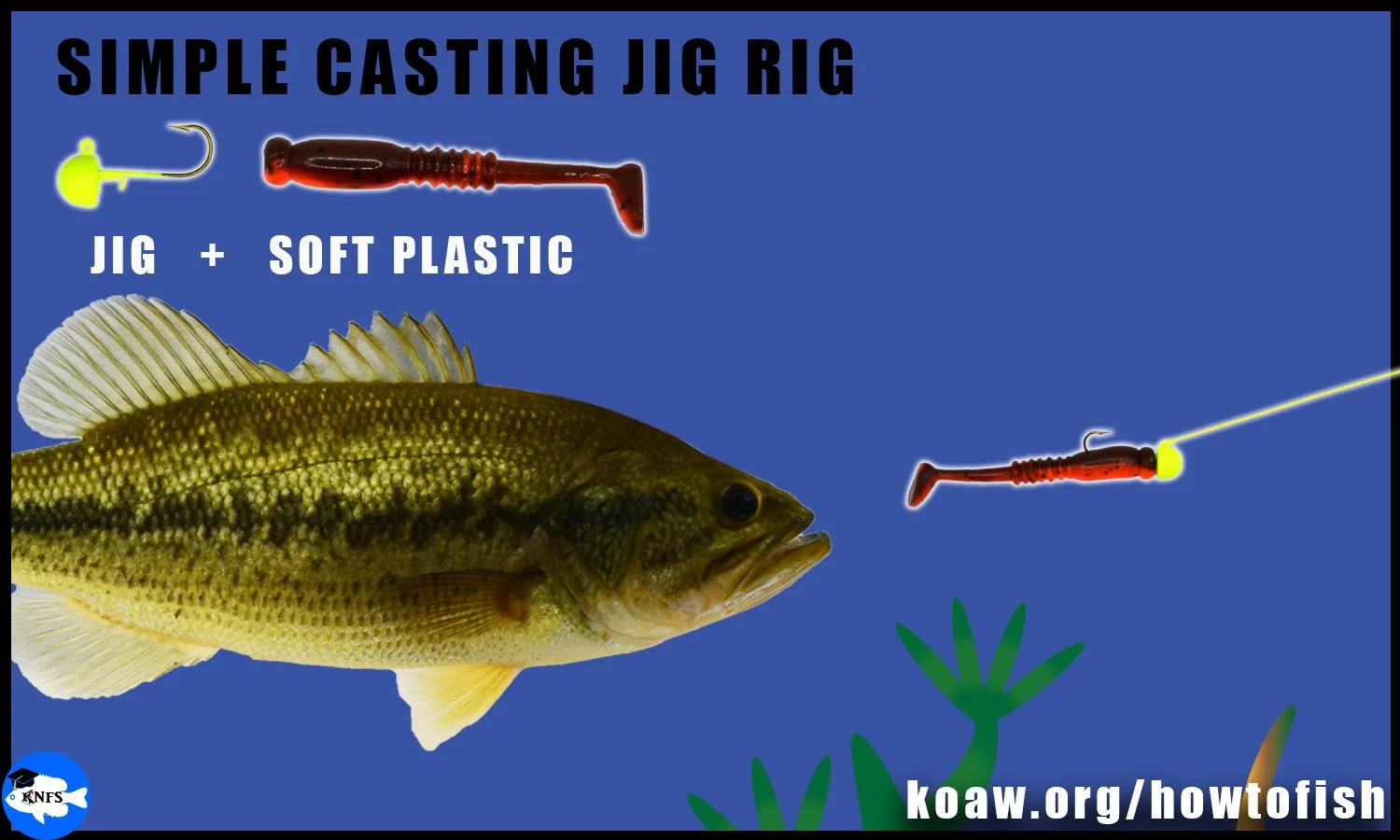
On this page we’ll go over how to construct this simple casting jig rig as well as how to play, or fish, this rig.
To tie this rig, you’ll need the following:
From what was covered on the ‘Starter Rigs’ page, you should have the following items:
a weighted jig-head (with molded-in hook)
a soft plastic
From what was covered on the ‘Basic Gear’ page, you should have the following items:
a reel on a rod
fishing line spooled onto that reel. (See KNFS YouTube video on how to spool line onto a baitcaster / spinning reel here.)
line cutters
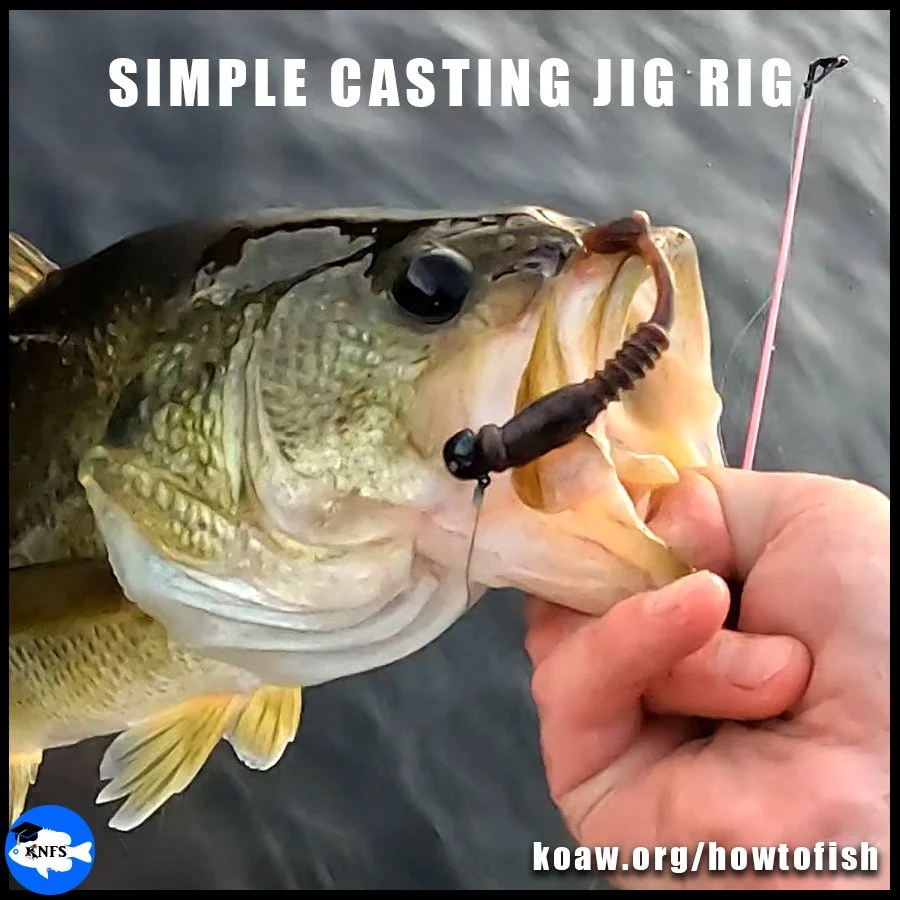
A Largemouth Bass (Micropterus nigricans) captured on a Mule Fishing 3/32 oz weighted jig-head and Donkey Tail soft plastic.
WHAT FISHES WILL THIS RIG CATCH?
This rig can be fished in freshwater and saltwater.
Saltwater rigs may require denser soft baits and/or a heavier weighted jig-head as saltwater is denser than freshwater.
This rig will be difficult to play in any aggressive water.
Multispecies rig (catches many different species.)
This rig is meant to catch predatory fishes that eat other animals (other fishes, amphibians, annelids (worms/leeches), large insects, etc.).
For example, in one body of water in Wisconsin this same rig caught Walleye, Northern Pike, Largemouth Bass, Smallmouth Bass, Bluegill, Pumpkinseed, Yellow Perch, and Black Crappie.
Shows the versatility of the rig when tied.
This rig does well…
being cast from shoreline/boat (discussed below)
Can target various depths, mostly 1’ to 6’ (0.3 m to 2 m) from the surface.
Can be played through light vegetation though this rig is not weedless.
being changed to a jigging rig from shoreline/boat
Can target depths anywhere from the benthic (bottom) to surface.
Turns more into a Ned Rig when bouncing the bait off of the bottom.
being changed to a trolling rig from a boat
Can target various depths depending on speed of vessel while trolling.
Must maintain fairly slow speed.
This rig does not do well…
being cast into lily pads or other thick vegetation.
Though this rig can be played through plants, it will still snag plants.
being played in very aggressive waters.
Unless using a very heavy jig to help better control the action.
Attaching the soft plastic to the hook may seem like an easy skill. However, you’ll find that it may take some practice. A sloppy attachment will decrease the intended performance of the bait. Each soft plastic has an intended ‘wiggle’ in the water. This wiggle creates a visual and vibrational presentation meant to replicate a live prey item and entice a fish to bite.
Step 1 - ATTACH SOFT PLASTIC TO HOOK:
1.1 Figure out where the point of the hook will pop out of the plastic:
Place your weighted jig-head down so that the hook faces away from you.
Place the soft plastic down so that the deepest portion of the tail faces towards you.
Align the head of the soft plastic with the bottom of the weighted jig-head (not including the hook.)
As is seen by the double arrow in #1 of the adjacent image, the alignment of the early-to-middle portion of the bend in the hook aligns with where the point of the hook will emerge.
Mark (or remember) that spot on the soft plastic with where the point of the hook will emerge.
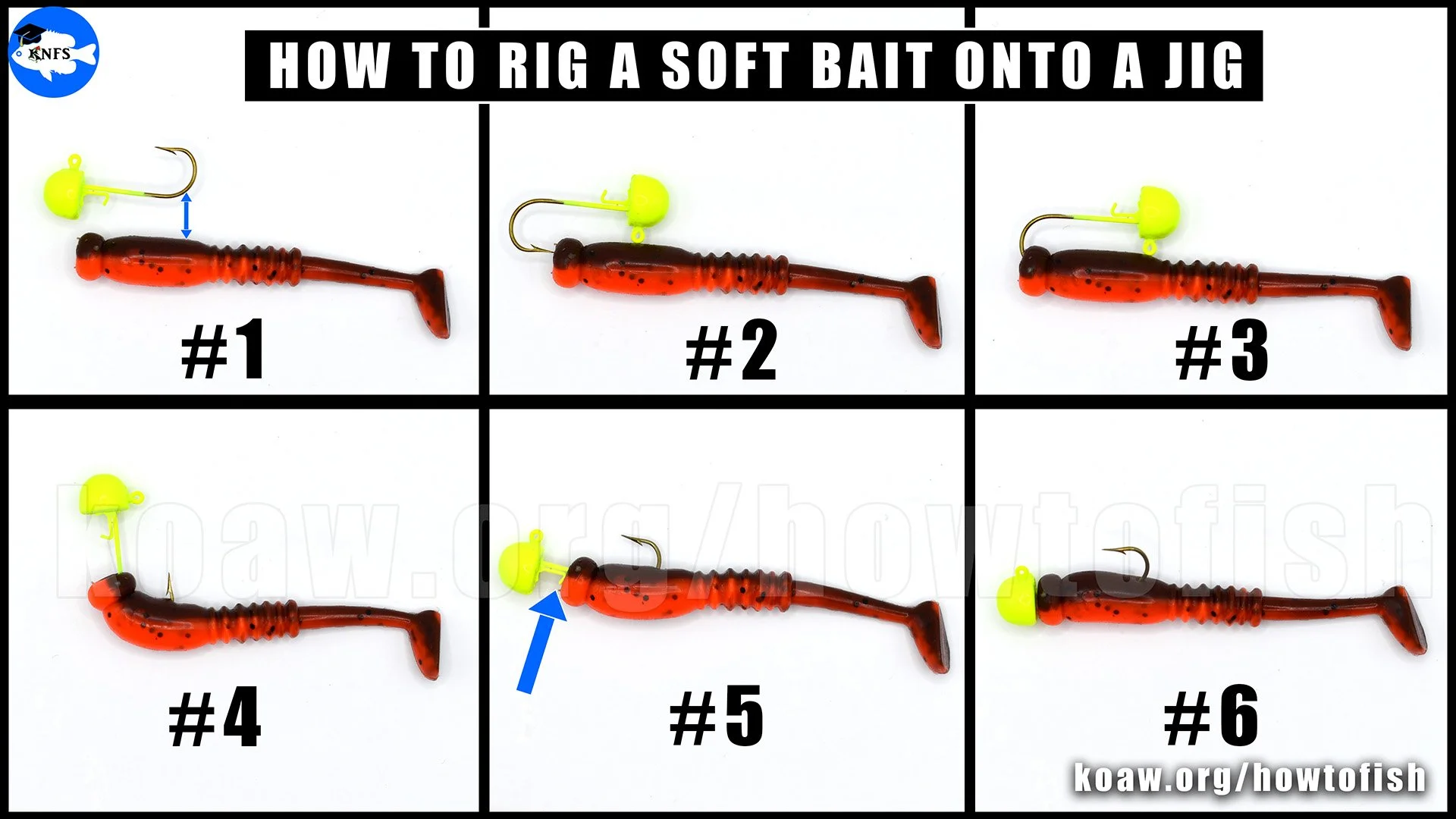
Shows the steps for sliding a soft plastic over the hook on a weighted jig-head rig. Specifically, this is a Mule Fishing 3/32 oz weighted jig-head with a Donkeytail paddletail soft bait.
1.2 Prepare to insert the point of the hook into the soft plastic:
Flip the weighted jig-head around so that the hook faces towards you.
Align the point of the hook with the center or top 1/3 of the head of the soft plastic.
1.3 Insert the point into the soft plastic:
Firmly hold both the soft plastic as well as the weighted jig-head.
Insert the point into the soft plastic while keeping the soft plastic and weighted jig-head parallel.
1.4 Slide the point along and emerge the point:
While firmly holding the soft plastic and weighted jig-head, begin pushing the point deeper into the soft plastic while also rotating the sharp point upwards so that it will emerge from the spot you marked/eyeballed in Step 1.1.
Emerge the point from the soft plastic at the marked spot.
1.5 Push the shaft of the hook into the soft plastic:
Apply enough pressure to slide the shaft down into the soft plastic until it hits the bait keeper (marked by the arrow in #5 of the adjacent image.)
The bait keeper may or may not be present on your jig head—it’s simply a protruding piece of plastic, metal, or line that helps keep the bait on the hook.
1.6 Finish sliding the soft plastic on:
Give an extra bit of pressure to get the soft plastic over the bait keeper.
At this point, the soft plastic should be fairly straight (not scrunched) and the head of the soft plastic should be flush with the bottom of the weighted jig-head.
The good news is that this attachment does not need to be perfect to catch fish—just good enough.
How to spool your reel with line and ensure line is threaded correctly. Watch on YouTube instead.
Step 2 - TIE ON THE RIG:
2.1 PREPARE THE LINE:
If the reel is not yet spooled, see the adjacent video to spool the reel.
Ensure that the line is threaded correctly through the level wind guide on the baitcaster, or for a spinning reel, correctly underneath the bail.
Ensure that the line is threaded through each eyelet along the shaft of the rod.
2.2 TIE A KNOT:
Attach the rig to the line via a terminal knot.
You’ll feed the line through the eyelet on the jig to begin this knot.
See below for how to tie a knot.
HOW TO TIE A KNOT:
The adjacent video will show how to tie one of the simplest, strongest terminal knots in fishing, the Palomar Knot.
With this casting rig I prefer to use the San Diego Jam Knot, however, this is a difficult knot for a novice angler to learn.
Tips for mono / fluoro line:
Click to enlarge. Shows how to tie a Palomar Knot with mono / fluoro line.
If attempting the Palomar Knot and you chose to use thicker line and are unable to easily thread in the folded line through the eye, simply just thread in the tag end (cut end) first, pull out some line, and thread it through again. If the line still doesn’t fit through the eyelet of the hook, then you’ll need to use a different knot that doesn’t require the double eyelet threading, like the San Diego Jam Knot.
Assembling the rig is really that simple!
Step 3 - Casting the rig:
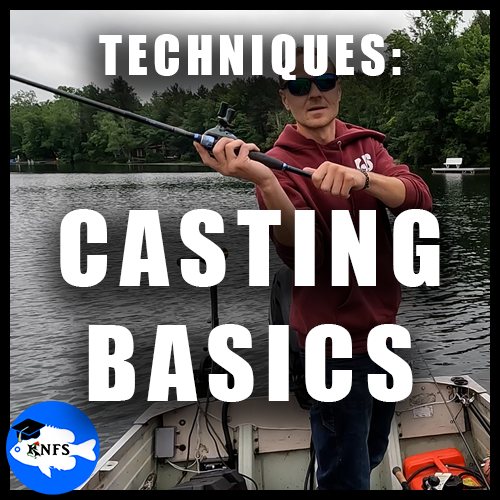
3.1 KNOW BASIC CASTING MECHANICS:
I prepared a tutorial page on basic casting mechanics for the three rod and reel combinations most frequently used. Refresh on this casting mechanics material if needed.
Again, this rig is best played with a spinning reel and rod with light line on a light to medium-light rod.
Click to enlarge.
3.2 BEST HABITATS TO CAST TOWARDS:
Over submerged plant beds, shelters, and other structure.
Aim to cast beyond the structure.
When the lure hits the water, let it drop but not so far as to let it snag any structure.
Open water situations.
Allow the rig to fall to a desired depth.
A slower retrieval (cranking) will keep the lure at a deeper depth.
Bounce this rig off the bottom.
Edges of weeds, piers, wood piles, shelves, and other structure.
Aim for a lane that brings a retrieval very close to (but not in) structure where fish may be hiding within.
This rig is not weedless but it is fairly good at not snagging plants compared to a larger rig and/or one with multiple hooks.
If snagged into a weed, give a good tug and the rig might release the attached weed.
STEP 4 - PLAYING THE RIG:
Playing, finessing, working, and other terms are used to describe the actions an angler can give to the rig to put the rig into a certain position and entice a fish to strike. Different rigs have different performance capabilities; some rigs are meant to be finessed while others are not.
Let’s go over some ways to finesse this rig and keep in mind that all of the combinations below could be implemented during the same retrieval. Most of the soft baits will have their own built in ‘wiggle’, or natural movement, that occurs when the soft bait is pulled through the water on the rig. The paddletail on the soft bait in the images above has a distinct wiggle.
PLAY STYLE #1 - The Straight Retrieval
Click to enlarge.
The straight retrieval is exactly as it sounds.
1. Cast the rig out.
2. Crank in to retrieve the rig.
Using a light to ultralight rod will really help you feel the wiggle of your soft bait in the water.
Practice retrieving the rig at various speeds to see how your rig changes depth with various cranking speeds.
A slower retrieval will keep the rig deeper.
Holding the rod tip lower towards the water during the retrieval will keep the rig deeper.
A faster retrieval will bring the rig closer to the surface.
A slower retrieval will cause the soft bait’s tail to wiggle less.
Advanced Skill: Twitch the bait during retrievals.
The key here is not to twitch too hard and/or too fast.
A fish still needs opportunity to nab the bait, so offer gentle portions of your retrieval.
PLAY STYLE #2 - Dropping the Rig
Dropping the rig means letting the rig fall straight down deeper into the water. Some fish will instinctively strike a rig the moment the rig stops moving horizontally and begins falling vertically.
1. Cast out.
2. Let the bait immediately fall for at least 1-2 seconds.
Either start with your rod tip high, stop cranking the handle, and lower your rod tip or, for deep drops, pop the bail to let out line.
Make sure to minimize the amount of slack in the line.
If no strike, resume the retrieval to bring the rig higher into the water column.
Give a quick twitch to the rig when resuming the retrieval (sometimes this quick twitch triggers the fish to strike.)
3. After about 3-5 cranks, let the rig drop again.
Rinse and repeat.
PLAY STYLE #3 - The Off-The-Bottom Bounce (Essentially turns rig into a Ned Rig)
This play style is great for off-the-bottom feeders, like the Smallmouth Bass, one of the absolute strongest fighting fish in North American waters. (Yes, a Smallmouth Bass fight is way more fun than a Largemouth Bass fight as the Smallmouth Bass dives and jumps much more often than Largemouth Bass.) Other black basses, like Largemouth Bass, will still hit on this play method.
Soft plastics have varying buoyancies. Some will sink when you put them in the water—some will float—and some may be so close to the density of the water source that they neither really sink or float.
Grab an extra soft plastic (should you have one) and get a small container full of the water you’ll be casting into. (Or just go to a shallow part of the shoreline.)
Click to enlarge.
If fishing saltwater, you’ll need to use water of the same density.
Add about 1/2 cup of salt from your kitchen to a gallon of tap water to roughly match this density.
If fishing freshwater, some water from the tap would work fine.
PLAY STYLE #3 - Continued
Knowing what your rig does in the water is very important. We can’t always sight fish, or a type of fishing where we are physically able to watch the performance of our bait as it is playing underwater.
Knowing that the soft plastic I’ve chosen for this demonstration is very buoyant in freshwater, I know that when I’m bouncing this rig off of the bottom, the heavy part of the jig will be on the bottom and the tail will be pointing upwards, offering some wiggle.
Cast out.
Let the rig fall to the bottom.
Make sure you are in an area without snags.
With your rod-holding hand, flick your wrist upwards in a pulsing motion.
You can do this in bursts of like 5 or so.
You can do this once and wait.
Keep slack out of the line.
If you are pulsing heavily, then you are likely adding a bit of slack as you are pulling the rig just a little bit each time you pulse.
Make sure to slowly crank (reel in) that extra slack as you do this.
One cast could take minutes to retrieve when implementing this off-the-bottom technique.
Patience is key, as it is with most fishing methods.