Jimbo, a KNFS community contributor, holds a very large Walleye (Sander vitreus). Note that this is not the most conservative way to hold a Walleye/Sauger.
In North America, the genus of Sander offers two species regularly encountered by anglers - Walleye (Sander vitreus) and Sauger (Sander canadensis). The hybrid of these two species, Saugeye, is frequently stocked for sportfishing purposes by state wildlife agencies. Species of this genus offer decent fights on rod and reel and are prized for having delicious meat.
Disclaimer: Hold and process fish at your own risk. There is always potential risk of incurring harm to your body when fishing and handling fish, even if all precautions are followed.
Click to enlarge. The blue arrows primarily point to the sharp, long caniniform teeth. The white arrow is pointing to the sharp tooth patches on the upper pharyngeal jaw. The black arrow is pointing to the toothy structures on the back of the gill arches.
DO WALLEYE & SAUGER HAVE TEETH?
Yes, the members of Sander have large, very sharp caniniform teeth capable of severely damaging an angler’s hand.
Walleye teeth are present in various places around the mouth expressed mostly as caniniform and cardiform; sharp toothy structures also exist on the gill arches as well as existing on the pharyngeal jaws.
The only way to ‘lip’ a Walleye, Sauger, and Saugeye without harming a hand is by wearing appropriately armored gloves.
The adjacent photo is not demonstrating the ‘lipping’ method, a holding method often used for holding black basses, like a Largemouth Bass. Instead, the photo demonstrates an alternative mouth holding method demonstrated below.
Image shows spine locations for the genus Sander. The fish in the photo is a Sauger (Sander canadensis).
DO WALLEYE & SAUGER HAVE SHARP SPINES?
Yes, the members Sander have sharp spines in the first dorsal fin, second dorsal fin, the pelvic fins, and the anal fin.
An angler needs to fold these fins downward starting from the head and moving towards the tail in order to collapse the fins and prevent them from ‘sticking’ the angler. The gill plate also has sharp elements that could damage an angler’s hands.
If handled incorrectly, these spines could pierce the skin of an angler’s hand.
The scales might look harmless at first glance, but they can cut an angler’s hand fairly easily.
DO WALLEYE & SAUGER HAVE SHARP SCALES?
Yes, Walleye, Sauger, and Saugeye have sharp scales spread over most of the body and head.
The ctenoid scales on these fishes have spiny projections posteriorly. If an angler, barehanded, rubs a fish from tail to head then the hand of the angler will likely experience damage.
Always try to wet hands and gloves before handling a fish to help minimize the amount of mucous membrane removed from the fish when handling.
Fish grabbers are a way for an angler to maintain a secure grip for dehooking without putting hands near the sharp teeth. However, fish grabbers tend to do a lot of damage to the mouth structures of a fish.
Gloves are recommended for holding members of the genus Sander.
As most anglers do not wear gloves, I am offering some practical strategies for holding with various methods.
As was mentioned in the general ‘Holding a Fish’ page, if safety of the fish is of high concern, then the perfect release would involve not removing the fish from water and not touching the fish at all. However, most anglers cannot do this—or even want to attempt doing this.
Minimizing the time the fish is out-of-water as well as minimizing the handling is most beneficial for the fish.
Fish grabbers are helpful for anglers that have trouble with grips and holds.
Fish grabbers tend to break jaw bones and damage other mouth parts.
Work Within Your Comfort Zone:
Some anglers may not be able to bend over too much, hold a fish with enough grip in certain ways, and/or perform holds that require more dexterity and strength.
An angler needs to understand their strengths and weaknesses for holding fish, then approach a fish with a holding method the ensures a success and safety.
2 SPOT BODY HOLD FOR SMALL AND LARGE SPECIMENS:
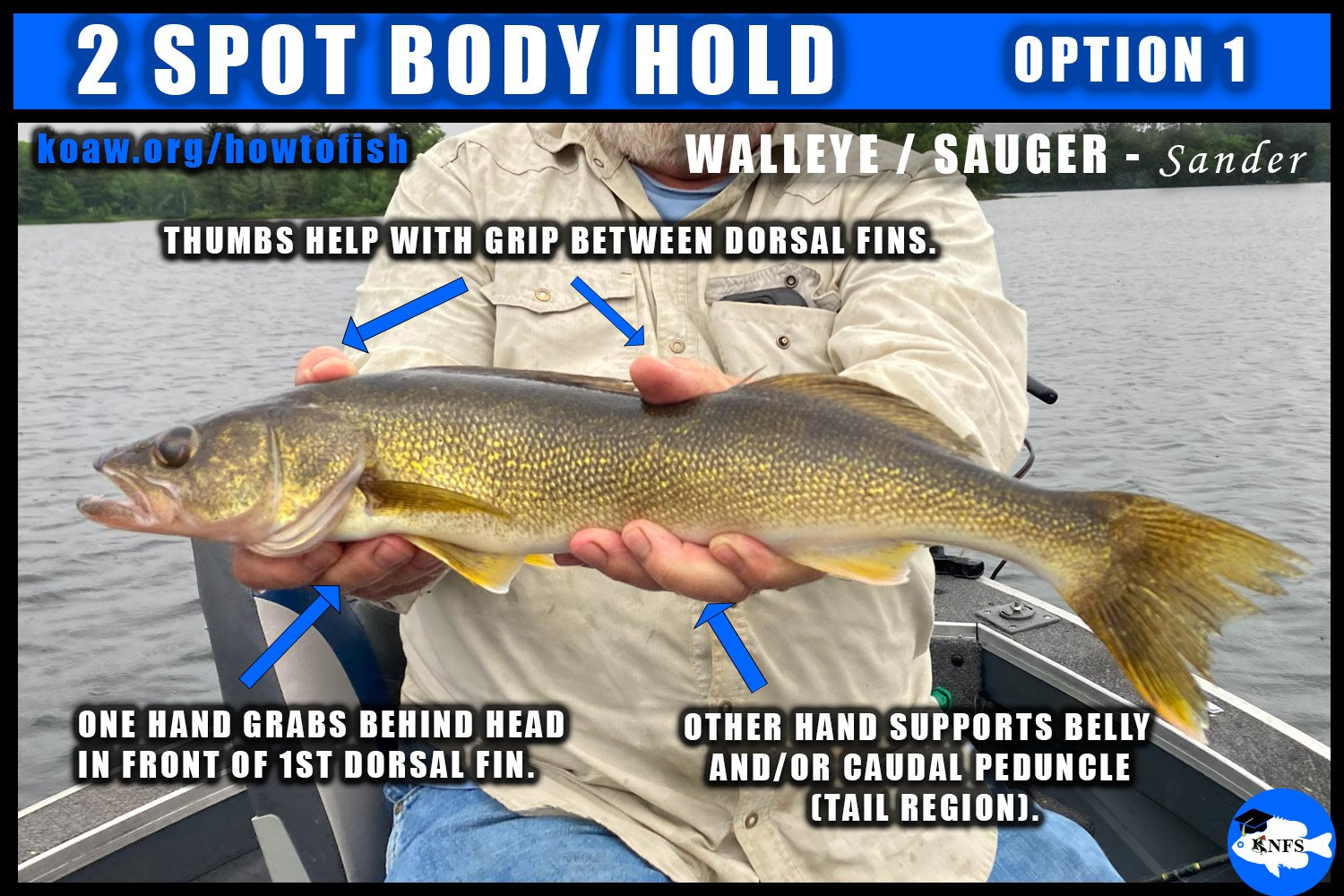
Jimbo holds another fine Walleye (Sander vitreus) without gloves. Again, each angler must decide whether or not to protect their hands with gloves while assuming the risk.
Option 1 and Option 2 of the ‘2 spot body holds’ are more beneficial for the fish if removing the fish from the water compared to using fish grabbers.
Koaw shows another method for holding a Walleye (Sander vitreus) that does not involve reaching inside the mouth.
INSIDE-MOUTH GRIP + BODY HOLD FOR MEDIUM TO LARGE SPECIMENS:
The next holding method is not recommended to novice anglers or anyone not wearing gloves because there is a very high risk of an angler cutting their hands and/or causing harm to the fish. Nevertheless, I will still demonstrate how I do this hold on members of Sander as, if done correctly by somebody confident in their grips, can better aid in removing hooks and processing a fish more efficiently.
The inside-the-mouth hold is complicated and risky. An angler should only do this hold if willing to accept the risk of getting cut, especially if doing it without gloves.
There is a fine line for error when holding fish this way. Be careful—approach at your own risk.
#1 - First secure the lure and control the fish this way.
Grab the hard, solid part of the lure away from the hooks.
#2 - With the lure secured with one hand, slide the index finger (and middle finger on larger fish) alongside the inner, frontmost portion of the branchiostegal membrane.
The branchiostegal membrane is the long, fleshy area underneath the gill plate. Notice the many curved bones inside the branchiostegal memebrane.
Pressure of the fingers should be pressing outwards (towards the angler) from the inside.
Slide slowly.
Don’t let fingers go all the way to front as there are many teeth.
Keep fingers pressed downwards that way if they bump into teeth, they will not be over the teeth and can be carefully backed away.
Koaw holds the Walleye (Sander vitreus) for demonstration.
#3 - Careful to avoid teeth.
Do not back fingers away quickly and backwards as there is a chance of snagging the teeth on the gill arches.
Do not let fingers go all the way forward or more central as there is a chance of snagging teeth.
#4 - Bring the thumb to squeeze against the soft tissue of the fish and index finger.
This grip should be very firm.
#5 - Dehook the fish while keeping a secure grip with the hand now holding the fish by the mouth.
#6 - When lifting fish from the water, the other hand will go to support the belly to distribute weight.
#7 - When carrying and moving the fish, make sure to maintain a firm grip in the mouth as well as a supportive hold on the belly.
#8 - When releasing the fish, get the tail in the water and then release the belly.
Gently put most of the fish in the water, then release the thumb pressure.
Slide the index finger (and middle finger if present) out of the fish’s mouth.
While sliding the fingers out, maintain a slight pressure outwards (towards you) along the branchiostegal membrane so as to prevent snagging teeth if the fish squirms.
Ideally, a fish should be processed in less than 30 seconds outside of water. If need be, return a fish to the water (e.g. - livewell or net) if gear needs to be moved or a camera needs to get ready.